Wednesday, 7 June 2017

Regularis Concordia - the Rule Book for Anglo-Saxon Monks

In the tenth-century, three men worked hard to restore the monasteries to their former glory. All these men were subsequently venerated as saints: Dunstan, Oswald, and Æthelwold.

In particular, Æthelwold of Abingdon, later bishop of Winchester, was determined that the monks and nuns of England should follow the Rule of St Benedict.

Æthelwold was the author of the Monastic Agreement of the Monks and Nuns of the English Nation, or Regularis Concordia, a document with which I'm familiar because of the wording of its preface, and the fact that, in it, Æthelwold acknowledges the status of Queen Ælfthryth, wife of King Edgar, and a leading character in my book, Alvar the Kingmaker.


A page from Regularis Concordia

However, having finished my latest piece of research, for an upcoming publication for Pen & Sword Books, I thought I would study the content of this rule book in a little more detail, to find out what those tenth-century monks and nuns could expect of their daily routines.

Some of the rules are very specific: 

"[during Lent] Whenever the subdeacon wears a chasuble he shall take it off when reading the epistle, and put it on again as soon as he has finished. The deacon, too, before coming forward to read the gospel, shall take off his chasuble, fold it and then adjust it crosswise about his left shoulder, making the lower end thereof fast to the girdle of his alb."

"On those same days of Lent when the Mass is ended, the bell shall be rung for Vespers and there shall be a space for prayer. Then, in the interval while the bells are ringing, those ministers who wish to shall partake of the mixtum; those who do not wish to shall have permission to forego it."

Such detail is the stuff one imagines being drawn up by committee, and there are sections of the Rule where one can hear the provisos echoing down the centuries:

"The brethren, vested in albs, if this can be done and the weather permits, shall go to the church."
If wet, in the village hall?

Much of the Rule is taken up with such ritual - the order of service for every part of the day, and the canonical year, is laid out. "None shall be recited when the second bell has rung. After None, they shall say for the King, Queen and benefactors the psalms Qui regis Israel and De profundis...rising up from the meal, they shall give themselves to reading or to the psalms...Vespers shall be celebrated punctually..."

However, there are also rules which cater for the basic human needs: "Thus in winter, when storms are harsh and bitter, a suitable room shall be set aside for the brethren wherein, by the fireside, they may take refuge from the cold and bad weather."


St Benedict by Fra Angelico

There is a chapter dedicated to the care of the sick within the monastic community: "Let there be therefore in that house brethren...who shall furnish the sick brother with everything he wants; if indeed it is necessary, let the help of servants be employed under a careful brother." Later, it states that "If the sickness improves, the visiting shall be discontinued, but if not, it shall be kept up until the death of that brother." There are further instructions for the washing and laying out of the deceased's body. 

This rule book is so much more than a prescription for the litany. Every aspect of daily conduct is considered. Were they a silent order? It seems not:

"The auditorium is excepted from the rule of silence; indeed, it is called by that name chiefly because it is there that whatever is commanded by the master be heard; neither is it right that tales of gossip should go on there or anywhere else." 


Now, as a teacher and a parent, I know that rules aren't laid down for no good reason. It makes me smile to think that these monks must occasionally have been prone to tittle-tattle.

Safe-guarding is also evidently nothing new: "Not even on the excuse of some spiritual matter shall any monk presume to take with him a young boy alone for any private purpose but, as the Rule commands, let the children always remain under the care of their master. Nor shall the master himself be allowed to be in company with a boy without a third person as witness."


Much is said about confession, and those who are "conscious of the guilt of sin or of weakness of the flesh shall not hesitate, in their fervent practice of the exercises of the monastic state, to receive the Eucharist daily...let those who are invited to the Lord's Supper beware lest, stained with the filth of sin, they dare to draw nigh to it unconfessed  and unrepentant."

But it was not all prayer, confession and hard work:
"On Saturdays, the brethren shall wash their feet, for which purpose each shall have a suitable basin. Having washed their feet, those who need to shall wash their shoes also."

Then "the prior shall strike the little bell and all shall assemble with thanksgiving to draw their measure of drink."

Alas, this was only a precursor to more prayer and only then could they file into the refectory.


Reading this document, one gets a sense not only of the seriousness with which the Rule was supposed to be observed, but of the daily rituals and concerns of those who led the cloistered life. Hitherto, I had only known of the historic and political importance of this document, its place in the timeline of the great monastic reform of the tenth-century, its bold statement affirming the status of the King's wife, and its enjoining of her to become the "fearless guardian of the communities of nuns" and its role in placing Æthelwold of Abingdon in the history books as one of the leading lights of the reform movement.


Now I feel I know a little of those anonymous black-robed monks, who lived behind the monastery walls, who were free to "give themselves voluntarily to private prayer" but who must not "dare to enter and frequent the places set apart for nuns." 

When they were on a journey, they were not to "waste time in idle talk," but when receiving visitors they had to be "most zealous in providing every kind service in the guesthouse." Indeed, it was laid down that "wayfarers, shall on their departure be provided with a supply of victuals according to the means of the house."


I can see them now, bustling about their daily business. This little rule book meant much to the reformers, and to the monks. It's also been invaluable to me.

Older Anglo-Saxon blog posts:
Anglo-Saxon Names
Wulfric Spott: A Mercian Man of Means

Wednesday, 10 May 2017

On Anglo-Saxon Marriage

Tradition has it that it wasn't much fun being a married woman in medieval times. Novels and films often lead us to believe that men were entitled to beat their wives, that women had no say in whom they married, that all their property belonged to their husbands etc etc... Was this true, and more pertinently, was it true for the Anglo-Saxon period?


A document, Concerning the betrothal of  a woman, suggests that it was not.
"If a man wishes to betroth a maiden or a widow, and it so pleases her and her kinsmen..."
It seems that the woman herself had to accept the suitor before the betrothal can proceed. Furthermore:
"The bridegroom is to announce what he grants her in return for her acceptance of his suit, and what he grants her if she should live longer than he... then it is right that she should be entitled to half the goods - and to all, if they have a child together - unless she marries again... he is to strengthen what he promises with a pledge, and his friends are to stand surety for it."
Clearly, whatever she is granted is guaranteed, and is hers to keep if they have a child together. It seems like quite a civilised arrangement, affording her a little bit of financial security.

The document bears no date, but it has been suggested that it probably dates from somewhere between 975 and 1030.


What other sources can shed light on the property rights of married women?

A marriage agreement between Wulfric and Archbishop Wulfstan's sister, dated somewhere between 1014-16, seems to confirm the guaranteed grants.
"He gave her the land at Alton to give and to grant to whomsoever she pleased during her lifetime or after her death."

An Old English agreement from Kent, dated between 1016-20, explains that, when Godwine wooed Brihtic's daughter,
"He gave her a pound's weight of gold in return for her acceptance of his suit, and he granted her the land at Street with everything that belongs to it, and 150 acres at Burmarsh and in addition 30 oxen,  and 20 cows, and 10 horses and 10 slaves."
and makes clear that: 
"Every trustworthy man in Kent and Sussex, thegn or ceorl, is aware of these terms."
These are agreements between families. What can the lawcodes tell us?

The laws of Ethelbert of Kent 602-603 decree that: 
"If anyone lies with a maiden belonging to the king, he is to pay 50 shillings compensation. If it is a grinding slave, he is to pay 25 shillings; if a slave of the third class, 12 shillings."
So, not too helpful, except to tell us that slaves had varying value. Although later in the same code we learn that:
"If a freeman lies with the wife of another freeman, he is to atone with his wergild*, and to obtain another wife with his own money, and bring her to the other's home." 
Oh dear; definitely a case of 'spoil my property, bring me a new one.'

And yet, we read that,  
"If anyone buys a maiden, she is to be bought with a bride payment." 
And that, 
"If she bears a living child, she is to have half the goods, if the husband dies first. If she wishes to go away with the children, she is to have half the goods." 
But, if anyone,
"carries off a maiden by force, he is to pay to the owner 50 shillings."

The later laws of Kent (673-685) dictate that:
"If a husband dies leaving wife and child, it is right that the child should accompany the mother, and he is to be given one of his paternal kinsman as a willing protector."

Wihtred of Kent's laws (695) declare that: 
"foreigners, if they will not regularise their marriages, are to depart from the land with their good and their sins."
No doubt this is a reference to religion and law, rather than any protective prescription for women.


Alfred's laws in the ninth-century seem to suggest that any affront to women is actually an insult to the men who 'own' them: 
"And a man may fight without incurring a vendetta if he finds another man with his wedded wife, within closed doors or under the same blanket, or with his legitimate daughter or his legitimate sister, or with his mother who was given as a lawful wife to his father."
But his laws also place special emphasis on the pregnant woman: 
"If a woman with child is slain when she is bearing the child, the woman is to be paid for with full payment  and the child at half payment  according to the wergild of the father's kin."
and, 
"If anyone rapes a girl not of age, that is to be the same compensation as for an adult."

King Æthelred the Unready's code of 1008 mentions that:
"Each widow is to remain unmarried for twelve months; she is then to choose what she herself will."
This suggests that a woman had a fair amount of choice, dispelling the notion that women were married off for monetary or political gain.


It's fair to say that the codes are mainly concerned with law, property, punishment, thievery, murder and rules of trade, as well as observance of holy law. But these women do get a mention. They are at least considered, and they do have rights.

Although, in the laws of Cnut, a man committing adultery is to pay compensation for it, according to the deed,  but if a woman commits adultery during her husband's lifetime  she becomes a public disgrace, forfeits her goods, and loses her nose and ears. So there's a little disparity there...

But if any man dies intestate, the property  is to be: 
"Very justly divided among the wife, the children and the close kinsmen, each in the proportion that belongs to them."
Cnut's laws also expand on Æthelred's, concerning the widow who remains unmarried for twelve months, decreeing that if she remarries, she forfeits the morning-gift and other possessions obtained through her first marriage. But,
"A widow is never to be consecrated as a nun too hastily" 
and, 
"neither a widow nor a maiden is ever to be forced to marry a man whom she herself dislikes, nor to be given for money, unless he chooses to give anything of his own freewill."
So, by the 1020s at least, women could be safe in the knowledge that they could not be forced into marriage, or into a convent.


But I'll close with this last little nugget. If a man brings stolen property into the house, unless it is under the wife's lock and key, she is not deemed guilty. But, 
"she must look after the keys of the following: namely  her store-room, her chest  and her coffer." 
If the stolen property is found in any of these, she's guilty.

Imagine the eleventh-century housewife's frustration, though, that: 
"No wife can forbid  her husband to place inside his cottage  what he pleases."
After the equivalent of a late-night drunken internet shopping spree:-

"Wulfgar, tidy up that 'bargain second-hand shield, one careless owner, slight spear damage'. And no, you can't put it in my coffer."

"Well, it'll just have to stay on the table, right next to the relic of St John the Baptist's foot, 'only three left in stock'. And there's nothing you can do about it." 

*Wergild - essentially a 'man-price': the value of a life, depending on rank

Other related posts:
Anglo-Saxon Names
Wulfric Spott: A Mercian Man of Means
A Brother Receives a Letter - and a Telling-Off

Wednesday, 19 April 2017

A Brother Receives a Letter - and a Telling Off

I do a lot of research, often revisiting a particular few years of the tenth century which are perhaps less well-known but are of great interest to me. From 955AD to around 980 there was little in the way of Viking activity in England but there was plenty of political manoeuvring, quite a few convenient royal deaths, and oh, a couple of civil wars... 

Most of the documents I study were written by clerics, and usually about 'important' people - kings, heirs to the throne, wives and women of kings. Almost all of these are mentioned as part of the stories of clergymen, those venerated as saints.


But tucked away at the end of a huge book*, my go-to source book, in fact, I rediscovered this gem, a letter written to a 'brother Edward'. It's written in the vernacular, a rarity for this period, and if one reads it as if it's addressed to a family member, it takes on a surprisingly contemporary tone, even though it addresses concerns very specific to the time of the Danish invasions:

"I tell thee also, brother Edward, now that thou hast asked me, that you do wrong in abandoning the English practices which your fathers followed, and in loving the practices of heathen men who begrudge you life, and in so doing show by such evil habits that you despise your race and your ancestors, since in insult to them you dress in Danish fashion with bared necks and blinded eyes. I will say no more about that shameful mode of dress except what books tell us, that he will be accursed who follows heathen practices in his life and in so doing dishonour his own race."
Elsewhere in the letter, the author asks Edward to try to stop 'a disgusting habit among women in rural districts, since he more often goes among these than does the writer'.

This made me smile. In fact there is so much that is wonderful about this missive, not least the opening line, "Now that thou has asked me..." 

Is there a little bit of smugness, too, that it is only Edward who goes more often among women in rural districts? I note that the writer implies that he does occasionally venture there himself, but never so frequently as the wayward brother. And what is the 'disgusting habit'? We are not told. Is this because this letter was not written for posterity, but simply to a brother gone off the rails? One can almost hear the drawing of breath, the whisper, "You know exactly what I'm talking about."


Obviously written at the time of Danish invasion, this letter is a delight, not only for its rarity but because of the wonderful image it conjures up. One can imagine that Edward is mixing with the wrong crowd, has quite had his head turned by the fancy and trendy invaders and has taken, much to the author's, maybe his family's, consternation, to following this new fashion. The 'blinded eyes' does not refer to 'cool shades', but one feels it is the middle-ages equivalent. 


Plus ca change...

*English Historical Documents Ed Dorothy Whitelock

Other related blog posts:
Anglo-Saxon Names
Wulfric Spott: A Mercian Man of Means

Tuesday, 4 April 2017

No Alums, Veri Pore: The Norwich Census of 1570

Going through some old history notes recently, I came across this little gem of a document. I've no idea how I came by it, (I have a facsimile; I don't think I'm on any museum or library 'wanted' list!) but as an historian who has close ties with Norfolk, I found it of great interest. I know Norwich very well, and I also love to pick at primary source documents to see what they can tell us of the people who lived in centuries past.

It contains details of the Parishe of St. Stevenes. The chancel of St Stephen's Church dates from 1522, and the church is one of three in the 'New French Borough', an area near the castle where 98 Saxon homes were demolished to build the stone edifice which signalled that the Normans were here to stay.


St Stephen's Church, by Ian Capper via CC Licence

In the later medieval period, around a third of the population of Norwich was made up of 'Strangers', Flemish Protestant Refugees. The famous Strangers' Hall in Norwich is only a five minute walk from St Stephen, but the first census entry I looked at was of the Rowe family, who have dwelt here ever, in other words, they were 'natives'. The head of the family, Robert Rowe, was 46, a glasier, and in no worke. His wife Elisabeth that spinne white warpe had five children. They lived in Thomas Mason's house and received no alms.


Strangers' Hall  - Public Domain Image

John Hubbard, 38, was a butcher and he and his wife had also dwelt here ever, but unusually for a butcher, his status was registered as no alums but verie poore.

Thomas Pele, 50, was a cobler in worke and Margarit his wyfe of the same age that spinne white warpe had three children. The elldist of the age of 16 yeres that spinne, and the other of the age of 12 and of 6 yeres that go to scoole, and have dwelt here 9 yeres and came from Yorkshere. Thomas and Margarit both had work, and the youngest children went to school, and yet they lived in the parish house, with no allums but verie pore.

John Tastes, a cordiner (cordwainer), and his wife who sewed, had two children at school, and lived in Mrs Broune's house with no alums, indifferent.


Mousehold Heath, Norwich - John Crome, Public Domain

John Burr was a 54 year old glasier, but verie sicke and worke not and his wife Alice that spinne had 7 children. The youngest was 2 yeres that can spinne woole. They lived in John's own house and had dwelt here ever.

The eldest on this document is John Findley, who at 82 years was not registered as 'past work' as some other elderly residents of Norwich were, but simply listed as a cowper not in worke along with his wife, Jone, who was siklie and yet spinne and knitt. They also had dwelt here ever, but in the church house, with a payment of 4d, and they were verie pore.

A quick scan of the whole Norwich census reveals that very few people, if in receipt of any payment at all, had any more than 4d.

To give an idea of the amount 4d would buy,

In another part of Norwich, in the Parish of St Gregory's, a poor man died, and his property was valued in an inventory taken by William Rogers and Gregorye Wesbye on 15th October, 1599.


St Gregory's by Adrian S Pye, via CC Licence

One borded bedsted 3s. 4d
One mattress and one under cloathe 1s. 6d
One flocke bed 2s. 6d
One bolster 2s. 0d
One downe pillowe and an old cushaigne 1s. 6d
Two leather pillowes filled with feathers 3s. 4d
One payer of shetes 2s. 0d
One bed blanket 1s. 8d
One old cofer 2s. 0d
One drye barrell 3d
2 salt boxes 1s. 0d
One hake, a fyer pann, a payer of tonges and a rosting yron 1s. 6d
One litle ketle, a sawer and 3 pewter spoones 2s. 6d
3 little boles 1s. 0d
One ketle, one potspone, 28 trenyens 1s. 0d
2 woodinge platters and 5 dishes and twoo erthen potts 8d
a stone pott and 5 galley pottes 4d
a hamper and certen old washe 6d
4 frayles and 2 stooles 3s. 0d
3 chiselles, 2 hamers and a perser 3s. 0d
(suggesting he was a carpenter by trade)
3 old cushings 6d
2 payers of hand cuffes and one dozen of hand kerchers and an old pillowbere 2s. 6d
2 old shirtes 1s. 8d
One old forme and 2 old cappes 1s. 0d
Total: £1 18s. 5d


Strangers' Hall Museum - a richer setting than our census houses

Ever wished to go back in time? Much as I love Norwich, I think I'd go back as a wealthy merchant. At the very least.


Wednesday, 8 March 2017

Wulfric Spott - A Mercian Man of Means

Last month I wrote about Anglo-Saxon names, and mentioned Eadric Streona (the 'Grasping'). He does come into this story, but I wanted to talk about another man with an odd name: Wulfric Spott, a Mercian man of means.

Wulfric Spott was a man of wealth, but he wasn't an ealdorman; he was 'merely' a thegn, but he witnessed 43 charters as a minister and he had lands in Staffordshire and Derbyshire, estates in Shropshire, Leciestershire, Nottinghamshire, Warwickshire, Gloucestershire, Lincolnshire and South Yorkshire. His will also refers to lands in South Lancashire and Cheshire. He was the founder of Burton Abbey at Burton on Trent.


Confirmation of Wulfric's will, 1004

Straight away his will demonstrates his wealth:
First I grant to my lord 200 mancuses of gold, and two silver-hilted swords and four horses, two saddled and two unsaddled, and the weapons which are due with them.
A mancus of gold would be the equivalent of 4.25g, or a unit of around 30 pieces of silver.

Wulfric makes various other grants of land, but to his daughter he leaves a portion of land which seems to be exempt from the usual terms:
And the land at Tamworth is not to be subject to any service not to any man born, but she is to have the lordship.
As well as bequests of huge parcels of land - "And I grant to Aelfhelm and Wulheah the lands between the Ribble and the Mersey, and in Wirral" - he leaves personal items:
And I grant to my god-daughter,[the daughter] of Morcar and Ealdgyth, the estate at Stretton and the brooch which was her grandmother's.
The family of Wulfric Spott was one of the most influential and powerful of its day, with branches linked to the royal family and a regular involvement in power struggles and political rivalry. 


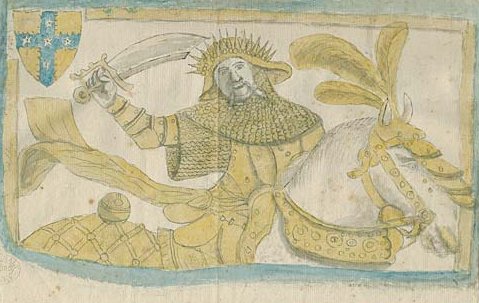
Wulfric seated on a horse, wielding a sword and clad in mail
Wulfric, from an 18th C pencil drawing of the stained glass window at Hall Hill, Abbot's Bromley

Wulfric Spott's brother Aelfhelm, ealdorman of Northumbria, was murdered in 1006, and his sons Wulfheah and Ufegeat were blinded. Wulfheah was one of the prominent ministri during the reign of Aethelred II (the Unready) and it's generally believed that Eadric Streona, ealdorman of Mercia 1007-1017, was Aelfhelm's murderer. His rise to power certainly would not have been hindered by the removal of prominent men who surrounded the king. The rivalry does not seem to have stopped there, for Eadric is named as the murderer of Sigeferth and Morcar, thegns of the Seven boroughs*. These brothers were members of this same family; Morcar was married to Wulfric Spott's niece. There is a possibility that they were related to King Aethelred  through his marriage to the daughter of Thored of Northumbria. 


Vacillating between the causes of Edmund Ironside and Cnut in the war of 1015-16, Eadric was playing a dangerous game. Edmund had defied his father, Aethelred II, and married Sigeferth's widow, thereby gaining the allegiance of the Northern Danelaw. Cnut's English wife, Aelfgifu of Northampton, was the daughter of the murdered Aelfhelm and the cousin of Ealdgyth, Morcar's widow. 

It is also possible that this family was connected to that of Leofwine, who held Eadric's ealdordom after the latter's death. His son Leofric succeeded him, and his son Aelfgar married Aelfgifu , who may have been the daughter of Ealdgyth and Morcar.

The Encomium Emmae Reginae shows us how important this family was. 


British.Library.MS.Add.33241.jpg
The Encomium Emmae Reginae - Emma receives it from the author
(her sons Harthacnut and Edward are in the background)

It was written for Cnut's second wife Emma, as a propaganda exercise for the claims of her son, Harthacnut, and in Book III it denies that Harald is Cnut's son. This in itself is not enough to refute Harald's claims, and the Encomium further denies that he is Aelfgifu of Northampton's son. Clearly his position as her son is important. If Emma denies that he is of this family, then she is not attacking them. The importance of Aelfgifu's kinship is clear, and Emma does not wish to offend this great family.

It's not clear exactly when Wulfric died, but the charter issued by Aethelred confirming his will is dated 1004 (pictured above) so we must assume that he died before this date. His mother, Wulfrun, was a noblewoman, after whom Wolverhampton is named. Hers was the only recorded name among the hostages taken by Olafr Gothfrithson when he took Tamworth in AD940. The fact that Wulfric Spott was also known as Wulfric son of Wulfrun, rather than of his father, suggests that she was a wealthy woman whose status outranked her spouse's.

From his will, it's clear that Wulfric did not squander any of the family fortune.


*The Five Boroughs or The Five Boroughs of the Danelaw were the five main towns of Danish Mercia (what is now the East Midlands). These were Derby, Leicester, Lincoln, Nottingham and Stamford.  There is a unique 1015 reference to the 'Seven Boroughs', which may have been included Torksey and York.

Wednesday, 8 February 2017

Anglo-Saxon Names

I wrote a blog some time ago about why I thought it was that the Anglo-Saxon era is one of the less popular. 

It's not often studied in schools - indeed, I had to wait until my degree course before I was offered the opportunity to study it - and it's a bit, well, far away. Not as far away as the Romans, though, or the Ancient Greeks.

What probably doesn't help is the names.


In an average day's writing, I can find myself with at least one Aethelwold, an Aelfhere, a couple of Aelfric's, an Aelfsige, an Aethelweard and several Aethelreds. Aelthelflaed, Lady of the Mercians, was far from being the only woman of this age who was given that name.

Of course, I know who they all are. Just as you might know one or more people named Michael; you will be able to distinguish them in your mind. So much so that you hardly notice that Michael from the office, who drives you mad with his habit of tapping his pen on the desk while he works, has the same name as your lovely Uncle Michael who always brings presents when he visits. So it is with me: I know that Bishop Aethelwold of Winchester, formerly abbot of Abingdon, is a completely different person from Ealdorman Aethelwold of East Anglia. And that neither of them has anything to do with Aethelwold, son of Aethelred, who fought at the battle of the Holme in 902 and held a nun hostage...

'Aethelwold' silver penny
To be fair, the Anglo-Saxons were no different from any other age in this regard. Pick up a book set in the later middle ages and you will find the pages littered with Williams, Richards and Edwards. Henry is quite popular too. I believe one or two kings even bore the name 😉

Later on, in the Tudor age, try getting away from folks named Thomas - Thomas Wolsey, Thomas Cranmer, Thomas Cromwell, Thomas More, Thomas Tallis...

Parents or teachers today will see the same trends in the classroom. When my children were little, it seemed like every other male child was named Matthew or Daniel, and common girls' names were Hannah and Bethany.

The main problem with Old English names is that they are Old English. They're not familiar, because they essentially come from another language. In written form, they look odd. I haven't used the diphthongs but if I did, they would look even more 'foreign.'

Æ and æ turn the name Aethelflaed into Æthelflæd, which looks better to me, but I imagine it's more difficult to read if one is not used to the OE alphabet characters. Turn it into Æðelflæd and it looks even worse!

Charter of Aethelflaed, Lady of the Mercians and Aethelred, her husband

So what do these names mean?

Most OE names of this period are composites. The Aethel, or Æthel prefix means 'noble'. 
We also have the prefix Ælf, which means 'Elf'.
Ead, as in Eadred or Eadgar, means 'blessed'. This prefix is very common, and is the original prefix of names such as Edward, Edwin and Edgar.

The endings of names have meaning, too.
Wine means 'friend', so Aethelwine translates as 'noble friend'.

Red, or more properly ræd, means 'counsel'. Thus we have the most famous of all puns on a king's name. Aethelred the Unready, whilst he might always have been caught a bit unawares by boatloads of Danes, was not actually named thus because of his inability to anticipate the Viking raids.

Originally his epithet was a play on words: His name, Æthelræd, means noble counsel. Unræd means badly or ill-counselled. So in OE, Æthelræd Unræd  was 'noble counsel, ill-counselled. He was, as in the title of Ann Williams' biography of him, Aethelred, the Ill-counselled king.

Charter of Aethelred the Unready (detail) note all the 'Æ' names

Stān, meaning 'stone', when added to Æthel, gives us the name Æthelstān, or Athelstan, a fitting name for a king: 'noble stone'.

Other name endings include 'thryth', or ðryth, which means 'strength'. 
Thus, Queen Ælfðryth, or Aelfthryth, has a name which means 'elf strength'.

Many noblewomen's names end in gifu, meaning gift, and pronounced 'yiva'. Perhaps the best known of these is Lady Godgifu - modernised to Godiva (from Godyiva)


These names, by and large, are reserved for the 'upper classes', and are prevalent in the later portion of the period. Go back to the seventh and eighth centuries and you find more variety in the personal names, partly as a result of there still being separate kingdoms, with family, tribal and linguistic traditions. Thus the royal house of Mercia had two branches, known as B and C, with names such as Burgred on one side, and Ceolwulf on the other. Going back further still, the names get even stranger, but even so, patterns are detectable. Penda, Peada and Pybba were all from the same family. (And all male, which might seem strange to us - as was King Anna of East Anglia.)

Other OE names have a similar composition to the later, noble names, but are easier on the eye: compound names beginning with Wulf, for example, such as Wulfstan, Wulfric, and Wulfnoth. 

Older compound names are less easy for our modern eyes to read: Cynewulf, Cynethryth, and Cynegils, for example.

Some are simply delightful because they incorporate what we would refer to as nicknames.
Eadulf Cudel was an eleventh century nobleman from the north east. Cudel means cuttlefish.


Eadwig Ceorlacyng's nickname translates as 'king of the peasants' although we don't know why he was known as such.
Athelstan Rota was so named because he was Athelstan the Red, and so, presumably, red-haired.
It's fairly safe to assume the reason why Æthelweard the Stammerer was so called. Or how about Godwine the Driveller?
Possibly the most infamous was Eadric Streona - whose name translates as Eadric the Grasping, but one of my favourites is Æthelmær se greata - Aethelmaer the Fat.

Ladies, too, had their nicknames, although goodness knows whether Æthelflæd Eneda's nickname 'the duck' was meant as a compliment or an insult.


Another Æthelflæd was known as 'The White' (se hwita), perhaps to describe the colour of her hair? We must assume that Eadgifu Pulchre was rather beautiful, since her by-name means The Fair. 

The name Eadgyth Swan-neck (swanneshals) conjures up images of a beautiful, long-necked woman, perhaps someone like Audrey Hepburn, but somewhere along the way, many of these OE names became modernised and for a long time, fell out of favour. Some have seen a resurgence (Eadgyth becomes Edith), but then there's Cuthbert, Wilfrid, Mildred, Audrey (yes, there she is again, although Aethelthryth Hepburn doesn't have the same ring to it), and even, though it was never an OE name in and by itself, Ethel. Some, however, retained their popularity and their noble bearing - Alfred, Edmund, Edward.

I like them all - although I stopped short of naming my children after any of them! And pronunication? Well, take your pick:
Many people call her Ethelfled, Lady of the Mercians. But I have also heard her referred to as Athelflat. I know which I prefer. 

The difficulties with these OE names, and the evidence for the use of by-names or nicknames, helped shape my decision to modernise some names in my novels, and to give several characters nicknames or pet names.

So I gave my Aethelflaed a nickname: Teasel. If you want to know why, pick up the book - the pet name leads to some confusion...

To Be A Queen - the Story of Aethelflaed, Lady of the Mercians

Wednesday, 11 January 2017

Home - Where the Heart is?

Did you know that, in space, moss spirals? 

It doesn't not thrive, but it's not at its best. 

Not doing what it should.


It's not at home.

Home. It's literally a universal concept; it's the only one that E.T. the Extra-Terrestrial knows. Who among us hasn't at one time or another put on a silly voice, held out a finger and said 'E.T. phone home'?

At the end of the Mad Max film, Beyond Thunderdome, the narrator talks about how the group of children "Started the haul for home," and explains why they keep the oral tradition - so important in history - alive. "We lights the city... for all of them that are still out there ... there'll come a night when they sees the distant light, and they'll be coming home."

So what is home?

“The home should be the treasure chest of living,” said Le Corbusier, but this was an architect's point of view. The concept of home has little to do with its contents; in literary terms this is not what makes a house a home. There are lots of homes in book titles: The Little House on the Prairie, The Mill on the Floss,  while some fictional houses are memorable by name - Pemberley, Manderley (but these are settings, and whilst important, are not necessarily yearned for.)


Be it a house, a village, or just something loosely described as a homeland, it calls us. And the yearning to return to it is a powerful theme in literature. Although not central to the story, in The Lord of the Rings, the little hobbits dream of home; they remember the Shire with longing as they journey ever further away from it, and from what they know.

Languages all over the world have words for this feeling. In Japanese - 故郷を慕う (kokyō o shitau) means to pine for home.

They also have 離郷 (rikyō) which means to separate from one's hometown. It doesn't have an English equivalent and yet we can understand the sentiment, immediately.

The Welsh have hiraeth. It's a longing for one's homeland, but it's not mere homesickness. It's an expression of the bond one feels with one's home country.

In Portuguese, saudade is 'a deep emotional state of nostalgic or profound melancholic longing for an absent something or someone that one loves.'

And of course, with homesickness, the longing, invariably, is not simply for the place, but for the people there, too. As a bullied child at boarding school, my homesickness was as much about longing to go back to a place which offered unconditional love, as it was about missing my creature comforts.


The urge to return home is perhaps nowhere stronger than in the book, based incredibly on a true story, Follow the Rabbit-Proof Fence by Doris Pilkington, where three young Aboriginal* girls defy odds and the authorities to work their way home across nearly 1000 miles of Australian outback, using the aforementioned fence as a navigational aid.


The Rabbit-proof Fence 2005 - by Roguengineer under CC Licence


Yes, this was a true story, but a great deal of dramatic tension can be created in a novel by taking the character out of their natural environment.

The 'New kid in Town' can upset the equilibrium, as Vianne does in Chocolat, by Joanne Harris, when she arrives in the French village of  Lansquenet-sous-Tannes and scandalises the village and disturbs its occupants, for better or worse, or maybe they feel out of place, like the moss in space: Leo, in The Go-Between, is very uncomfortable in his new world - literally, since he has only a thick woollen suit to wear as the Norfolk summer temperature rises and rises. Not only has he been removed from his home, he has been transplanted to the world of another social class. He does not know how to act. More significantly, he is a child thrust into the world of adults, with disastrous consequences not only for him, but for them.


'Fair Use' Image

I subconsciously made use of this theme in my own novels. I didn't set out to do it, because the outline of an historical novel is, by definition, already in place, and yet I've recently realised that the theme is there in both of my novels and my short story. 

In To Be A Queen, a huge part of Aethelflaed's struggles hinge upon the fact that she is a 'foreigner', in a country she knew as a small child but yet is unfamiliar to her as an adult. She is not, initially, accepted and she reacts defensively, closing her mind to the possibility that these foreigners might be either as civilised, or indeed as brutalised, as her own countrymen have been. Much of the drama unfolds as the two 'sides' learn, gradually, to understand one another.

Surely there was nothing about this in my second novel? It's a fairly straightforward tale of love, lust, and politics. But, here again, is a character who is taken out of the world he knows; in this case, Alvar the fighting man, the local lord, finds that he has to contend with the deadlier arena of the royal court. If he knew the phrase 'fish out of water', I think he would readily have applied it to himself.

Now, I can see that I understood completely what each of these characters must have been feeling and that's why the theme permeated the books.

Is it because I was so frequently a 'new kid' myself that this aspect of their stories resonated with me, or is it, as I said, a universal condition, the sense of alienation which we all will feel when taken away from our cultural, spiritual or physical home? 

Even in my short story for 1066 Turned Upside Down, not only are the English, naturally enough, fending off the invaders who threaten their country, but my central characters, Edwin and Morcar, are also fighting for their homeland, and for their rights. 

I'm not 'from' anywhere. I'm a forces brat, and I have a sense of rootlessness that makes my story very hard to tell. The word 'belong' is a strong one. We humans need to be able to feel it as a truth. What happens when we are removed from home, and the quest to return to that place where we belong, makes for powerful drama.

~~~~~~~~~~

(If you want to know what the moss in space looks like - click on the link. I couldn't contact anyone to gain permission to use the image, but I can direct you to it. Take a look; it's the oddest thing  - NASA - Fire Moss)

*I did a bit of research into whether or not the term 'aboriginal' was acceptable. This issue is complicated (my thanks to Prue Batten for her insights) but on balance it would appear that the word is largely acceptable, so I have risked using it. I hope not to have caused any offence by so doing.