Showing posts with label Harthacnut. Show all posts

Saturday, 31 May 2025

Monthly Blog Post: June (and a bit of murder...)

 June already! In Old English this month was called Ærra Līþa "Before Midsummer", or sometimes Brāh-mānod "First Summer".

June is quite the month - it's a time for haymaking, harvesting early crops such as barley and, especially in Anglo-Saxon times, enjoying fresh dairy produce. Of course the summer solstice happens in June too.

Historically June is a month when big events happened: the sealing of the Magna Carta (15th June, 1215) and of course, more recently, the D-Day landings (4th June, 1944). 

But this month, there are two standout stories from the Anglo-Saxon era. They both tie in nicely with my new book, and the first apparently occurred on 1st of this month. So let's talk murder... child murder at that!

The Anglo-Saxon Crypt at Repton - my photo

We start with a royal power struggle in Mercia in the ninth century, and on the face of it, it's the story of a spoiled brat of a 'prince' *, Wigstan, who objected to his mother's remarriage. It seems as though Wigstan's mother had been married to a former king of Mercia, and her suitor was the son of his successor. On the face of it, it looks as though Wigstan, being of that age, was resentful that his mother was choosing to marry again. Things took a nasty turn though when he was murdered. Quite an extreme reaction, you'd have thought.

However, there's more to this than meets the eye (isn't there always?) because whilst it's not entirely clear whether Wigstan's father was ever king - though it does seem likely - there is no doubt that his paternal grandfather was. And here's where it gets complicated, because his maternal grandfather had also been a king of Mercia, which means that Wigstan had very blue blood indeed.

Mercian politics at this time was dominated by the power struggles between various branches of the royal family. It's a list of confusingly similar names and easiest described as a rivalry between kings whose names began with B, C, or W. For simplicity - it's explored at much more length in my new book - let's just say here that one of Wigstan's grandfathers was a C king, the other a W king, and the king who was trying to marry his son off to Wigstan's mother was from the rival B branch.

With this borne in mind, it starts to look as though the B king, having seen off his rival and was now sitting pretty on the throne, wanted to marry his son to the widow of a previous king, to bolster his credentials and strengthen any resulting dynasty. It looks as if Wigstan was just a bit too much of a threat to those plans, and it may be that he never objected at all to the wedding, but was sidelined - permanently - anyway.

This story is representative of so many of the murders in the book. It has a young victim, bloody coups, and many legends attached to it. There's also something less common about it, for it is possible to visit the crypt where Wigstan's bones were laid to rest, near his grandfather's. Underneath St Wystan's church in Repton, Derbyshire, the Angl0-Saxon crypt still exists. It's thought that this is where another Mercian king, Æthelbald, also murdered, was laid to rest. The Repton Stone, thought to represent this king, can be viewed in Derby Museum.

The Repton Stone - my photo

Do visit if you get the opportunity. You can get a 'three-for-one', because next door to the church in the grounds of the vicarage is where archaeological teams have been excavating a Viking burial ground. At the museum in Derby you'll also see the sarcophagus of St Alkmund, another alleged murder victim!

The next story from June is the death of King Harthacnut on 8th June 1042. It was not recorded as murder, but the description of his death does suggest that it might have been poison. 


Harthacnut came to the throne after the death of his half-brother, Harold Harefoot. They were both sons of King Cnut and after their father died an unedifying struggle for control ensued, largely spearheaded by their mothers, Queen Emma and Ælfgifu of Northampton respectively. Harthacnut’s inability to get back to England after his father’s death was a major deciding factor in Harold's election as king.

Harold only reigned in total for around five years, and Harthacnut only two. The family had a disposition for dying young, it would seem. Or did they?

We have a description of Harthacnut’s death: 

He was attending a wedding and, ‘He was standing at his drink and he suddenly fell to the ground with fearful convulsions, and those who were near caught him, and he spoke no words afterwards.’ It does look suspiciously like death by poison. Who would have wanted him dead?


One chronicle said that Harthacnut did nothing worthy of a king, and had Harold’s body dug up and thrown into a fen. 

In the year before his death he’d sent tax collectors to ravage Worcestershire and gather eye-wateringly high amounts of tribute, and two of these collectors were killed by the people of Worcester. Harthacnut was clearly making enemies. And matters weren’t helped when he then sent a large force to burn the city and ‘lay waste the whole province.’

None of the chronicles records foul play, and it’s probably unlikely that any citizens of Worcester made their way into the wedding, but could any erstwhile supporters of Harold Harefoot have got close enough to put poison in the king’s drink? 

Both these stories, and many more, are explored in my new book, Murder in Anglo-Saxon England: Justice, Wergild, Revenge.


*this term was not used at the time

Monday, 11 February 2019

Wealth, Power and Influence in Later Anglo-Saxon England

Last time I talked about defining nobility. Now I'll examine the careers and wealth of those noblemen.

The great magnates of Anglo-Saxon England were not poor men. Land has always been the most recognisable sign of wealth, and these men had plenty of it. The amount of land which a pre-Conquest nobleman could amass can be seen clearly in the case of Harold Godwineson. [1] As well as their own family lands, such men could hold land from their lord as reward for service. Bookland, as it was called, was originally granted by the king to his thegns with an ecclesiastical purpose in mind. By the tenth-century, however, land was being booked without any pretence that it would go to endow a church. Many thegns and ealdormen were benefactors of religious houses though - Wulfric Spott founded Burton Abbey, Athelstan 'Half-king', ealdorman of East Anglia 932-956, used his wife's lands to form the nucleus of the large endowment of Ramsey Abbey, [2] and  Ælfhere, ealdorman of Mercia 956-983, cited in the Anglo-Saxon chronicle as the destroyer of monasteries, [3] was a great friend to the religious houses at Glastonbury and Abingdon.


Dunstan - one time abbot of Glastonbury

The nature of the land grants varied little, and each one set out the conditions under which the land was booked. King Edgar granted to his thegn, Ælfwold, land at Kineton in Warwickshire as

"an eternal inheritance ... and after the conclusion of his life (he may) leave it unburdened to whatsoever heirs he shall wish. Also the aforesaid estate is to be free from every yoke of earthly service except three, namely fixed military service and the restoration of bridges and fortresses." [4]

It was not only the king who granted land. Oswald, bishop of Worcester, sets out the conditions under which he has granted his land in his letter to King Edgar. [5]

"That they shall fulfil the whole law of riding as riding men should and that they shall pay in full ... church Scot and Toll. In addition they shall lend horses, they shall ride themselves, and, moreover, be ready to build bridges, ... they shall always be subject to the authority and will of that archiductor who presides over the bishopric..."


King Edgar

The will of Wulfric Spott [6] is a fine example of the extent of lands in the possession of an influential thegn. He had lands in Staffordshire and Derbyshire, estates in Shropshire, Leicestershire, Nottinghamshire, Warwickshire, Gloucestershire, Lincolnshire and South Yorkshire. The will also refers to lands in South Lancashire and Cheshire.

The family of Wulfric Spott was one of the most influential and powerful of its day, with branches linked to the royal family and a regular involvement in power struggles and political rivalry. Wulfric Spott's brother, Ælfhelm, ealdorman of Northumbria, was murdered in 1006, and his sons Wulfheah and Ufegeat were blinded. Wulfheah was one of the prominent ministri during the period when Æthelred II (Unready) was restoring royal favour to the Church (see below).

It is easy to believe that Eadric Streona, ealdorman of Mercia 1007-1017, was Ælfhelm's murderer. His rise to power certainly would not have been hindered by the removal of such prominent men who had surrounded the king. The rivalry does not seem to have stopped there, for Eadric is named as the murderer of the thegns Sigeferth and Morcar.

These brothers were members of this same family; Morcar was married to Wulfric Spott's niece. There is a possibility that they were related to King Æthelred through his marriage to the daughter of Thored of Northumbria.

Vacillating between the causes of Edmund Ironside and Cnut in the war of 1015-16, Eadric was playing a dangerous game. Edmund had defied his father, Æthelred II (Unready), and married Sigeferth's widow, thereby gaining the allegiance of the northern Danelaw. Cnut's English wife, Ælfgifu of Northampton, was the daughter of the murdered Ælfhelm, and the cousin of Ealdgyth, Morcar's widow. It is also possible that this family was connected to that of Leofwine, who held Eadric's ealdordom after the latter's death. His son succeeded him, and his son Ælfgar married Ælfgifu who may have been the daughter of Ealdgyth and Morcar. So far, so confusing!


Encomium Emmae Reginae 

But the Encomium Emmae Reginae shows us how important this family really was. It was written for Cnut's second wife Emma, as a propaganda exercise for the claims of her son Harthacnut, and in Book III it denies that Harald is Cnut's son. This in itself is not enough to refute Harald's claims, and the Encomium further denies that he is Ælfgifu of Northampton's son. Clearly his position as her son is important. If Emma denies that he is of this family, then she is not attacking them. The importance of Ælfgifu's kinship is clear, and Emma does not wish to offend this great family.


Cnut with his sons Harald and Harthacnut

A simple equation which has always held true is that wealth equals power. King Æthelred II was called 'Unraed' because he was badly counselled. It is certainly true that for much of his reign he was guided by councillors acting in their own interests. The 980s were a period which Æthelred came later to regret. Many churches were deprived of their lands; an Abingdon estate was acquired by a king's reeve, and Rochester was besieged. Æthelsige, one of the five most prominent men at this time, was responsible for the damage done at Rochester. The king himself admitted that this was a period when he was being manipulated by a group of men who, taking advantage of his youth, were acting in their own interests at the expense of various churches. In the next decade the prominent men were associated with the monastic cause and royal generosity to the Church was re-established.

The king needed his councillors and officials. He rarely acted without the consent of the witan (council). Royal authority could only be made to be felt throughout the kingdom through the king's representatives. Yet it was all too easy for these men to become too powerful. The king rarely strayed from the south, and to the inhabitants of England north of the Humber, royal authority was remote.

Northumbria was never free from the Scandinavian threat, and the eorls (as they were called in the north) often had to deal with this problem on their own. It must have been difficult to trust them, but many thegns were encouraged to acquire estates in areas settled by the Danes, to help break down the isolation of the north. Another policy instigated was that of appointing archbishops to York who had sees elsewhere. This pluralism was designed to ensure ecclesiastical loyalty, and would also help to bring Northumbria out of isolation. Royal control was difficult to establish in areas with separatist feeling, and Mercia was another of these areas. The ealdormen, if they wished to assert themselves, had to establish links in order to gain and retain control, and at times this must have looked suspiciously like treachery. Poor communications also did nothing to alleviate the danger of an over-concentration of power in too few aristocratic hands.


Æthelred II 'The Unready'

During the reign of King Alfred, ealdormen usually controlled single shires, but as the West Saxon kingdom expanded the ealdormen were given greater responsibility. Athelstan of East Anglia's nickname 'Half-king' demonstrates how powerful these men could become. His ealdordom included East Anglia proper (Norfolk and Suffolk), Cambridgeshire, Huntingdonshire, north-east Northamptonshire, and he probably governed the whole of the eastern Danelaw. [7] He kept his ealdordom under such control that Kings Edmund and Eadred were able to recover first the northern Danelaw, then Northumbria, and finally to conquer Strathclyde.

It is not surprising to discover that men like these did not always work together in complete harmony. The anti-monastic reaction which followed the death of Edgar in 975 found ealdormen Ælfhere (Alvar in my novel) and Æthelwine on opposing sides in the succession dispute. Doubtless Ælfhere was antagonised by the triple-hundred of Oswaldslow which had encroached upon his area of authority, but it has been suggested [8] that he had other, more personal reasons for opposing Æthelwine's and Dunstan's support of Edward; namely that Æthelwine's ealdordom was East Anglia, and this meant East Anglia proper, Essex, and the shires which had at one time been the eastern part of the old kingdom of Mercia, and were still called Mercian in the tenth-century. Ælfhere, Æthelwine and Eorl Oslac of Northumbria were the most influential ealdormen of their day. Ambition and power perhaps inevitably cause conflict.


Thorkell the Tall, a Danish invader turned mercenary of Æthelred II, became the leading secular lord of Cnut's reign. He was made governor of Denmark for a time and guardian of the king's son. Cnut's letter to the people of England [9] instructs Earl Thorkell to deal with those who defy the laws. Dorothy Whitelock* suggested that this was because the letter was sent to him from Denmark by Cnut and that Thorkell was acting as regent in Cnut's absence. Power and trust indeed for a man who had earlier fought on the side of the English. Doubtless this was the kind of reward Eadric Streona had been seeking to secure himself when he changed sides during the war of 1015-16. He, of course, was not so fortunate. [10]

It is interesting to note that open conflict only occurred in times of unrest, for example during the succession dispute of 975, or the war of 1015-16. Athelstan 'Half-king' was loyal, as we have seen; Ælfhere of Mercia was invaluable to King Edgar when he was trying to assert himself as king of the Mercians. Only after Edgar's death did Ælfhere's resentment manifest itself. The king may have been ill-served upon occasion, and there is some doubt as to the effectiveness of the reeves as checks against the power of the ealdormen, but there was nothing in England to compare with the rise to power of the Capetians in France, and royal authority was never seriously challenged by the servants of the crown.


[1] Ann Williams - Harold Godwineson Battle 80
[2] CR Hart (in Anglo-Saxon England 2)- Athelstan Half-king and his Family
[3] Anglo-Saxon Chronicle (E) 975
[4] EHD (English Historical Documents) 113 page 519
[5] Origins of English Feudalism 42 p133
[6] EHD 125 p541
[7] CR Hart ibid
[8] Ann Williams - Princeps Mercorum gentis; the family, career and connections of Aelfhere, Ealdorman of  of Mercia 956-983
[9] EHD 48 p415
[10] The Encomium Emmae Reginae tells us Eadric's fate: "He (Cnut) said 'pay this man what we owe him; that is to say kill him, lest he plays us false.' He (Eric of Hlathir) indeed raised his axe without delay and cut of his (Eadric's) head with a mighty blow."
*Author of The Beginnings of English Society, & Wulfstan and the Laws of Cnut (English historical Review 62 1948)


Wednesday, 8 March 2017

Wulfric Spott - A Mercian Man of Means

Last month I wrote about Anglo-Saxon names, and mentioned Eadric Streona (the 'Grasping'). He does come into this story, but I wanted to talk about another man with an odd name: Wulfric Spott, a Mercian man of means.

Wulfric Spott was a man of wealth, but he wasn't an ealdorman; he was 'merely' a thegn, but he witnessed 43 charters as a minister and he had lands in Staffordshire and Derbyshire, estates in Shropshire, Leciestershire, Nottinghamshire, Warwickshire, Gloucestershire, Lincolnshire and South Yorkshire. His will also refers to lands in South Lancashire and Cheshire. He was the founder of Burton Abbey at Burton on Trent.


Confirmation of Wulfric's will, 1004

Straight away his will demonstrates his wealth:
First I grant to my lord 200 mancuses of gold, and two silver-hilted swords and four horses, two saddled and two unsaddled, and the weapons which are due with them.
A mancus of gold would be the equivalent of 4.25g, or a unit of around 30 pieces of silver.

Wulfric makes various other grants of land, but to his daughter he leaves a portion of land which seems to be exempt from the usual terms:
And the land at Tamworth is not to be subject to any service not to any man born, but she is to have the lordship.
As well as bequests of huge parcels of land - "And I grant to Aelfhelm and Wulheah the lands between the Ribble and the Mersey, and in Wirral" - he leaves personal items:
And I grant to my god-daughter,[the daughter] of Morcar and Ealdgyth, the estate at Stretton and the brooch which was her grandmother's.
The family of Wulfric Spott was one of the most influential and powerful of its day, with branches linked to the royal family and a regular involvement in power struggles and political rivalry. 


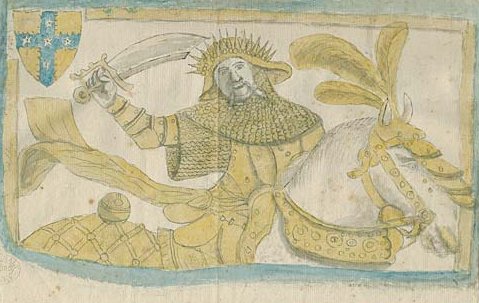
Wulfric seated on a horse, wielding a sword and clad in mail
Wulfric, from an 18th C pencil drawing of the stained glass window at Hall Hill, Abbot's Bromley

Wulfric Spott's brother Aelfhelm, ealdorman of Northumbria, was murdered in 1006, and his sons Wulfheah and Ufegeat were blinded. Wulfheah was one of the prominent ministri during the reign of Aethelred II (the Unready) and it's generally believed that Eadric Streona, ealdorman of Mercia 1007-1017, was Aelfhelm's murderer. His rise to power certainly would not have been hindered by the removal of prominent men who surrounded the king. The rivalry does not seem to have stopped there, for Eadric is named as the murderer of Sigeferth and Morcar, thegns of the Seven boroughs*. These brothers were members of this same family; Morcar was married to Wulfric Spott's niece. There is a possibility that they were related to King Aethelred  through his marriage to the daughter of Thored of Northumbria. 


Vacillating between the causes of Edmund Ironside and Cnut in the war of 1015-16, Eadric was playing a dangerous game. Edmund had defied his father, Aethelred II, and married Sigeferth's widow, thereby gaining the allegiance of the Northern Danelaw. Cnut's English wife, Aelfgifu of Northampton, was the daughter of the murdered Aelfhelm and the cousin of Ealdgyth, Morcar's widow. 

It is also possible that this family was connected to that of Leofwine, who held Eadric's ealdordom after the latter's death. His son Leofric succeeded him, and his son Aelfgar married Aelfgifu , who may have been the daughter of Ealdgyth and Morcar.

The Encomium Emmae Reginae shows us how important this family was. 


British.Library.MS.Add.33241.jpg
The Encomium Emmae Reginae - Emma receives it from the author
(her sons Harthacnut and Edward are in the background)

It was written for Cnut's second wife Emma, as a propaganda exercise for the claims of her son, Harthacnut, and in Book III it denies that Harald is Cnut's son. This in itself is not enough to refute Harald's claims, and the Encomium further denies that he is Aelfgifu of Northampton's son. Clearly his position as her son is important. If Emma denies that he is of this family, then she is not attacking them. The importance of Aelfgifu's kinship is clear, and Emma does not wish to offend this great family.

It's not clear exactly when Wulfric died, but the charter issued by Aethelred confirming his will is dated 1004 (pictured above) so we must assume that he died before this date. His mother, Wulfrun, was a noblewoman, after whom Wolverhampton is named. Hers was the only recorded name among the hostages taken by Olafr Gothfrithson when he took Tamworth in AD940. The fact that Wulfric Spott was also known as Wulfric son of Wulfrun, rather than of his father, suggests that she was a wealthy woman whose status outranked her spouse's.

From his will, it's clear that Wulfric did not squander any of the family fortune.


*The Five Boroughs or The Five Boroughs of the Danelaw were the five main towns of Danish Mercia (what is now the East Midlands). These were Derby, Leicester, Lincoln, Nottingham and Stamford.  There is a unique 1015 reference to the 'Seven Boroughs', which may have been included Torksey and York.

Tuesday, 31 May 2016

Wealth, Power and Influence in Anglo-Saxon England

On the EHFA blog this week, I explored the wealth, power and influence of the later Anglo-Saxon Nobility. Boy were these people rich!


Read the article HERE