Showing posts with label King Edgar. Show all posts

Wednesday, 30 April 2025

Monthly Blog Post: May, and Edgar's Coronation

The year is flying by, and I can hardly believe we're already in May.

In Old English, this month was known as Þrimilce-mōnaþ "Month of Three Milkings", because of the plentiful production of milk by the animals at this time of year. In this period, animals were 'dry' over winter, not milked all year round. This produced a glut in summer months, and so any cheeses made over the summer were soft, and any surplus then smoked for the autumn/winter. (There would still be a 'hunger gap' in the early spring, when preserved supplies ran out before the new crops etc were ready.)

We usually have two bank holidays in May, one at the beginning and one at the end. The first one is a fairly modern thing, but Whitsun is not. The late Spring Bank Holiday was still known as 'Whit Monday' until the 1970s.

Whitsun appears to be a contraction of 'White Sunday', a reference to the white garments worn by those baptised on that day.

In the year 973, it was an important time for another reason...

One of my favourites from this period is King Edgar, about whom I've written many times, in fiction and nonfiction. He had quite the reputation as a philanderer, which may or may not have been deserved.

King Edgar as depicted on the frontispiece of
the New Minster Charter, mentioned below

He came to the throne in 957, possibly as a boy of only 14. His father, Edmund I, had been assassinated when Edgar and his brother were infants, and was succeeded by their uncle. When he died, the kingship past to Edgar's elder brother, Eadwig. Described by most chroniclers* as a foolish boy, Eadwig gave away vast tracts of land in order to bolster support, but Edgar's foster-father, the powerful Athelstan 'Half-king' of East Anglia, helped to secure Northumbrian and Mercian support for Edgar, and for a while the kingdom was split, with Eadwig still in control of Wessex, and minting coins, and Edgar controlling the midlands and the north, and issuing charters as 'king of the Mercians'.

It wasn't a tenable situation, and in 959, aged only around 19, Eadwig died** and Edgar became king of a united England.

His epithet is Edgar the Peaceable, and it's true that there were no 'Viking' raids during his reign. He also facilitated the Benedictine Reform, spear-headed by archbishops Dunstan and Oswald and Bishop Æthelwold. The coinage was reformed during his reign, too.

The Monastic Reform was not to everyone's liking, and in its wake there was a bit of a free-for-all regarding Church land, and in fact after Edgar's untimely death in 975 the political situation descended into chaos, with land disputes, fighting, and an unedifying argument over the succession, which was resolved when his eldest son, Edward, was killed, leaving the way open for his youngest son Æthelred, to succeed. His epithet was rather less prestigous than his father's: 'unræd' (ill-counselled). 

Æthelred's mother was Edgar's last wife. It is said that he had three wives, but there is little evidence that the first, Æthelflæd Eneda, existed. Tradition has it that his second wife, Wulfthryth, was a consecrated nun who was tricked into marriage by Edgar. This story is an amalgam of several reports by later chroniclers, and it is likely that she had not taken her vows. She seems to have been the mother of the hapless Edward (epithet: the Martyr) and Edith, later St Edith of Wilton.

His last, and I think second, wife, was Ælfthryth, who had previously been married to his foster-brother, son of Athelstan Half-king. Again, stories abound: this first husband tricked Edgar into thinking she was not attractive, and married her himself; Edgar had him murdered; she duped Edgar into marrying her... Again, all probably untrue. She was also implicated by some sources in the killing of her stepson Edward, and was at various times accused of witchcraft and another murder.***

Edgar, as mentioned above, became full king in 959, but did not have a coronation ceremony until that Whit Sunday in 973. Many historians, myself included, believe that he might have been crowned earlier, and that this ceremony had added meaning. It took place in Bath, on the border of Mercia and Wessex, perhaps to signify his dominion over both erstwhile kingdoms, and happened when he was 30, the canonical age for a bishop. There was certainly an element of show. We are told that after this ceremony in Bath, Edgar went to Chester and was rowed along the River Dee and paid homage by several other kings, who now were deemed to be sub-kings. It was, by the looks of it, a show of Imperial Power, and again, the siting of the ceremony, the old Roman city of Bath, adds weight to this notion.

The really significant thing, though, is that Ælfthryth was consecrated queen alongside him. This was the first known instance of a queen consort being crowned.**** In an important document, a charter confirming the privileges of the New Minster in Winchester, it is clear that the eldest son of this union was given precedence over Edgar's son by Wulfthryth, Edward. Sadly for Queen Ælfthryth this did not stop his being elected king when Edgar died, at a comparatively young age in 975, just two years after the coronation. And she is always likely to be remembered as the wicked stepmother who ordered his killing, as shown in this image, where she welcomes her stepson to her house at Corfe, while her henchman prepares to kill him.


*One chronicler, Æthelweard, wrote of Eadwig in glowing terms, but was probably related to him and therefore biased.

** For an in-depth look at Eadwig's ill-fated reign and the political importance of his short-lived marriage, see my article here: https://t.co/uTmElKcyPR

***If you'd like to read more about Ælfthryth, please do check out my latest book, Murder in Anglo-Saxon England, which lays out all the accusations made against her, and challenges almost all of them! It also looks at the convenient, and timely for some, death of Eadwig, and challenges what is usually thought about the assassination of Edmund, father of these two young boys.


**** You can read more about Ælfthryth's life in general in my book Women of Power in Anglo-Saxon England.

I've also written a novel about Edgar's leading nobleman: Alvar the Kingmaker


Of which the Historical Novel Society said:

'Alvar is closely associated with both kings. Young, but mature and trusty, he helps protect, support and guide them and soon regards himself as a kingmaker. The novel develops his character along with the narrative. He does not have an easy ride. In love and respect he has to bide his time.

The conflicts between different factions and rival individuals surrounding Alvar’s life are convincing. They keep the drama flowing, and the women in the novel are nicely drawn, fulfilling the lifestyle expected of females at that time yet showing their individual personalities. They also have key parts in the action; Kata, for instance, the love of Alvar’s life, is depicted as quiet yet emotionally strong and open-minded.'

Well, I did say I'd written an awful lot about Edgar's reign! Thank you for reading and I hope you enjoy May, with all its wonderful blossoms. (Blossom is another lovely Old English word!)


Tuesday, 2 April 2024

King Eadwig's Short and Ill-Fated Reign

Some Anglo-Saxon kings are famous, for either being successful (Alfred the Great, Athelstan) or unsuccessful (Æthelred the Unready). Some have faded into obscurity or are remembered for only one thing. A case in point is King Eadwig, sandwiched on the regnal list between his uncle, Eadred, during whose reign 'Viking' York came under English control, and his brother, Edgar, remembered for keeping his kingdom united, reforming the coinage, and enabling the leading Churchmen of the age to instigate the Benedictine Monastic Reform. Even had he not been sandwiched between these two, Eadwig's reign was not successful, nor did he achieve anything much during his extremely short tenure, losing his kingdom within two years of becoming king, and having his marriage annulled a year later. He is chiefly remembered only for the scandalous story of his coronation. So what happened? 

Although England was technically a united country when Eadwig acceded in 955, old national identities were still strong. ‘Viking’ Northumbria, with its power base at York, had only ended the year before, and Mercia had rebelled against Wessex authority as recently as 924. A north/south divide was still keenly felt.

Fourteenth-Century image of Eadwig [Public Domain image: attribution link]

Eadwig came to the throne when his uncle died childless but he himself was only around 15 when he succeeded. His father, Edmund, was killed when he was a small boy, so his uncle, Eadred, became king and he and his infant brother Edgar were brought up in - separate - foster homes.

This last point is significant because, while we do not know precisely who was responsible for Eadwig’s upbringing, we know that his younger brother grew up in the household of the ealdorman of East Anglia (also part of the ‘Danelaw’), a man who had served three previous kings and was so rich and powerful his epithet was ‘Half-king’. 

Eadwig’s reign started badly. There are many versions of the tale but they all concur that the louche young man absented himself from his coronation feast and was found cavorting in bed with a noblewoman and her daughter. The fact that this daughter was actually his wife and queen consort mattered little to the outraged churchmen. An argument ensued, and the abbot who had found him, Dunstan of Glastonbury, one of the leading lights of the Benedictine Monastic Reform movement, was banished. There was another aspect to this dispute, however, one which appears to involve Dunstan’s retention of some royal treasure, and Eadwig’s despoiling his grandmother, Eadgifu (the wife of one king and the mother of two more), of her property. The stage was set.

‘Mortimer’ illustration (Drawing by Samuel Wale, entitled "The Insolent Behaviour of Dunstan to King Edwy on the Day of his Coronation Feast." in Thomas Mortimer's New History of England. 3 vols: vol. 1. 1764-6.)

Only one chronicler had anything good to say about Eadwig and, tellingly, he was related to Eadwig’s young wife. We cannot know about the personalities of those at court but the extraordinary number of extant charters show the young king granting away vast tracts of land which looks like an attempt to win support from the nobility. Eadwig’s wife was descended from royalty herself, a branch of the family which had rebelled in 902, sparking a battle in which Eadgifu’s father had been killed. The old guard might have seen this marriage as a potential threat. It was declared that the couple was too closely related and in 958 the marriage was annulled. But things had gone awry for Eadwig before then.

In 957, Edgar, the younger brother, became king of the Mercians. It is likely that Edgar was at this stage only around fourteen years of age, his brother about seventeen. It can be taken as read that he had the backing of the East Anglians, having grown up there, and he now courted the Mercians, whose support, along with that of the Northumbrians, was crucial. For a time, there were two courts, with Eadwig’s kingdom now restricted to the central heartland of Wessex. This might have been the Half-king’s plan all along.

Was it a rebellion? One chronicler said that the people ‘threw off their allegiance to Eadwig.’ Eadwig continued to issue charters, but only for land in Wessex, while Edgar was styled ‘King of Mercia’ in his. It might be that it was a pre-arrangement, as when Edward the Elder died in 924 and one of his sons inherited Mercia, another Wessex. (A short-lived arrangement, with the Wessex king dead after sixteen days). 

Edgar recalled the exiled Dunstan and appointed him bishop of Worcester but Eadwig, still officially king of the English, appointed a married man and father, the bishop of Winchester, as the new archbishop of Canterbury. The biographers of Dunstan and the other reformers did not approve; Eadwig was proving to be the obstruction to certain ambitions. Conveniently for some, the archbishop elect died on his way to Rome, and Dunstan took the role.

Possible image of Dunstan praying before Christ

The reformers and the old guard now had Edgar in place as king of the ‘Danelaw’, a pro-reform archbishop, and another ally, the abbot of Abingdon, accusing Eadwig of distributing ‘the lands of the holy churches to rapacious strangers’.

Yet still Eadwig remained, albeit only as king of the West Saxons. An untenable situation, and one which was resolved when, in 959 and still aged only around nineteen, divorced and childless, Eadwig died. Edgar then became king of all England.

Eadwig had been elected by the Witan (council) as king, but from the outset there were factions at court who favoured his brother. Whether or not the division of the kingdom can be classed as a rebellion, its result was the same. And who can but wonder about the nature (unrecorded) of the young king’s timely death?


The opening scene of my novel, Alvar the Kingmaker

shows the moment when Abbot Dunstan discovers the young king 'rioting in the harlot's embrace' (as one Anglo-Norman chronicler put it). I've also related the incident in detail for The Historian Circle blog, where I looked at what we know of the king's young wife and the importance of her status. You can read the article HERE . I've revisited the reigns of Eadwig, his father Edmund and his uncle, Eadred, for my new book, Murder in Anglo-Saxon England: Justice, Wergild, Revenge, which was published in February 2025. 


For a look at the reign of Eadwig's predecessor, you can read my chapter on King Eadred in Kings and Queens: 1200 Years of English and British Monarchs edited by Iain Dale and published by Hodder & Stoughton.


Monday, 7 March 2022

Great Escapes

 It's Women's History Month so it seemed appropriate to put together some stories about courageous women who most certainly did not submit quietly to a fate dictated for them by others:

Let’s turn first to seventh-century Queen Æthelthryth, a member of the East Anglian royal family but married to Ecgfrith of Northumbria. He was perhaps ten years her junior and, famously, she was said to have been encouraged by Bishop, later Saint, Wilfrid to remain celibate. Bede said he heard the details of the story from Wilfrid himself, and explained how Æthelthryth gained her husband’s permission to enter a monastery, staying first with Abbess Æbbe at Coldingham Abbey and then becoming abbess of Ely.

Image of Æthelthryth - with kind permission
 of the rector of Hexham Abbey

The Liber Eliensis (a history of Ely Abbey compiled in the 12th century) tells a dramatic tale in which Ecgfrith, having initially agreed to the divorce, tried to remove her forcibly from the convent. Æbbe advised Æthelthryth that her only option was to escape. The king set off in pursuit, but Æthelthryth and her two lady companions climbed to the top of a steep hill where divine intervention caused the water levels to rise, cutting off the hill and keeping the holy virgins hidden for seven days. The king could not get near, and eventually returned to York. Unfortunately the nuns on the rock began to suffer from extreme thirst. The abbess prayed for them and in answer to her prayers, a spring of water gushed forth and provided the nuns the means with which to slake their thirst. The Liber Eliensis states that this story was not based on the writings of Bede but came from those who knew the area of Coldingham and were witness to the events. Well, whether the story is true or not, she got to Ely safely and became abbess, being succeeded there by her sister.

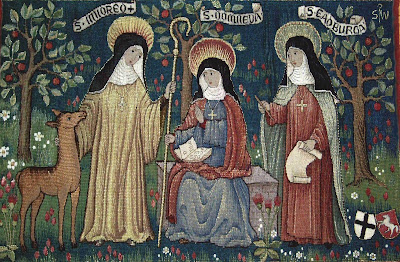
A contemporary of Æthelthryth, Mildrith was the daughter of Merewalh (a sub-king of Mercia and possible son of King Penda), and Domneva (Domme Eafe) a Kentish princess. Mildrith was sent abroad, to be educated at the abbey at Chelles. Goscelin of St Bertin said that while she was there, the abbess attempted to force her into marriage with one of the abbess’s kinsmen. When Mildrith refused to comply, she was put in a hot oven, but miraculously managed to escape. The abbess then beat her so viciously that her hair was torn out. Mildrith sent some of this hair to her mother as an SOS signal. Domneva sent a rescue party, although Mildrith refused to leave until she had collected some holy relics from her room.

 The delay meant that they were pursued and were only successful in escaping because the tide turned. When she at last returned to Kent and set foot on land, Mildrith left the imprint of her shoe on the rock at Ebbsfleet and transferred to it healing powers. Mildrith entered Domneva’s house at Minster-in-Thanet and eventually succeeded her mother as abbess. This family was quite a force to be reckoned with. Though not involved in any dramatic escapes of her own, Domneva tricked a king, her cousin, who had ordered the murder of her brothers, into giving her the land where she built the abbey at Minster-in-Thanet. Incidentally, Minster Abbey is still home to a community of nuns. 

Tapestry showing the first three abbesses at Minster - with kind
permission from the community there

Osith,(alternatively Osgyth or even Osyth) was a relative of Mildrith’s, if she’s correctly identified as the the daughter of a sub-king of Surrey, Frithuwald, and his wife Wilburh, sister of King Wulfhere of Mercia (possibly Merewalh’s brother). According to later, twelfth-century, stories she was brought up in Aylesbury in the nunnery of her aunt St Eadgyth. On a journey to meet another aunt, St Eadburh, she drowned in the River Cherwell but was revived by the prayers of her aunts. She wanted to remain a virgin but was married off by her parents to King Sigehere of the East Saxons, but she avoided consummating the marriage, putting herself under the protection of a bishop named Beaduwine. (There are echoes here of the story of Æthelthryth, of course, who similarly was under the protection of a bishop). 

Sigehere seems to have accepted the situation and given her land at Chich, where she built her abbey. She thus escaped marriage, but perhaps not with her life, for she was apparently kidnapped by pirates and beheaded after refusing to renounce her faith. In one version of her story, she was buried at Aylesbury, while in another she was buried at Chich, taken to Aylesbury for nearly fifty years, and then returned. If Osith was indeed the daughter of Wilburh, wife of Frithuwald, then a connection with Aylesbury, a probable royal minster, makes sense. Her story might have been confused with that of another lady of the same name, because there were two feast days and one explanation is that the temporary relocation of the relics from Chich to Aylesbury was an attempt to reconcile two separate cults. 

Illuminated capital depicting Saint Osith

Let’s fast-forward now to the tenth century where we find a woman, sometimes a nun, sometimes not, sometimes a royal wife, sometimes not, but who, in one version of her story, also had a dramatic escape.

Wulfthryth was the mother of King Edgar’s daughter St Edith of Wilton, and possibly his son, Edward the Martyr. She became abbess of Wilton and was later venerated as a saint, but before that was the subject of much gossip. It is not known precisely when she took up the religious life. Some sources state that she was a nun when Edgar met and seduced her.

According to Osbern of Canterbury, writing in the latter part of the eleventh century, Edgar seduced a nun of Wilton who gave birth to a son, Edward. But another source, a young contemporary of Osbern’s named Eadmer, said that Edward was the son of Æthelflæd Eneda (Edgar’s supposed first wife). Eadmer decided therefore that Edgar, a married man, sinfully seduced a laywoman who wore a veil in an attempt to avoid the king’s attentions. He said that the king went to Wilton and, “captivated by the beauty of a certain young girl” ordered her to be brought to him while she, out of fear for her chastity, “placed a veil snatched from one of the nuns on her own head.” Edgar though, was not fooled and, saying, “How suddenly you have become a nun,” dragged the veil from her head.  

Goscelin of St Bertin said it was St Wulfhild, abbess of Barking, who was in fact the object of Edgar’s attentions. She evaded him by escaping naked down a sewer, and so the king took her kinswoman, Wulfthryth, a laywoman being educated by the nuns, instead. Goscelin was however adamant that Wulfthryth became Edgar’s lawful wife and that they were bound by ‘indissoluble vows’.    

Veils and sewers notwithstanding, Wulfthryth seems to have been a canny administrator of Wilton. She purchased a collection of relics, and lands which had been granted to her by Edgar were conferred to the nunnery, presumably so that the abbey would retain the lands after her death. She was influential too: Goscelin related how she brought pressure to bear on King Æthelred when his officers tried to remove a thief who had claimed sanctuary in the church and the royal servants were blinded as punishment, and how she interceded on behalf of two priests imprisoned by the reeve of Wilton.

St Mary (Old Church) Wilton - attribution LINK

One of the escape stories has a less happier ending, though it’s not wholly one of despair. A woman named Cyneburh is named in the Gloucester Cartulary. According to legend, she was a Saxon princess who fled to Gloucester in order to avoid an arranged marriage. She took service with a baker, who was so impressed by her work that he adopted her as his daughter. This aroused the jealousy of the baker’s wife, who murdered Cyneburh. She then disposed of the body by throwing it into a well. When the baker returned home and couldn’t find Cyneburh, he began calling her name and she, though dead, answered him, thus revealing where her body was hidden. She was buried near the well, and a church was then built on the site. Thereafter miracles were recorded, with one woman being cured having lost the use of her muscles down one side of her body, another’s withered hand was restored, while someone else was cured of dropsy.

Sadly, it’s impossible to identify this lady. She is not Cyneburh daughter of Penda, for she married Alhfrith, son of Oswiu of Northumbria, nor is she Cyneburh of the West Saxons, wife of Oswald of Northumbria, who is generally assumed to have taken the veil at Gloucester and become abbess there. This lady of the well must either be a figment of the Gloucester chronicler’s imagination, or she is yet another woman whose full story might never come to light. 

I mentioned St Edith of Wilton briefly, and she has an escape story, or rather her leather and purple garments do (!) while Balthild the slave escaped servitude, and Judith of Flanders, having caused a scandal with her first two marriages, was locked up for her own good by her father and made her escape before marrying a third time. For more about those three indomitable women, see HERE


All these women’s stories are included in Women of Power in Anglo-Saxon England, and almost all of them feature in my novels, too.


Monday, 13 December 2021

Finding Stories in Legends: The Anglo-Saxon World

A royal son, in defiance of his frail and useless father, released the king’s prisoner from jail and married her, before leading the kingdom in an heroic fight against the invaders. A king went to war because his sister had been mistreated. A princess was accused of killing her little brother and her punishment was that her eyeballs fell out. A teenaged king was found in bed on his wedding night with his wife and her mother…

These are all tales worthy of books. Even Films maybe. But they’re tales of Anglo-Saxons, so you might not have heard of them. 

It’s less true now, thanks to The Vikings TV series and The Last Kingdom – TV series and books - but the Anglo-Saxon period has at times suffered from a lack of interest. 

But why? A bit of shameless name-dropping here: over lunch one day, Fay Weldon told me that she thought it had a fair bit to do with the costumes. The Tudors, for example, had exquisite clothing and accurate paintings which can be used to reproduce the garments for telly shows. The Anglo-Saxons left only drawings which lacked perspective and detail and yes, it’s fair to say that in comparison, their clothes were a shade less flamboyant.

There’s a big line, too, drawn across history and making a cultural and documentary barrier: 1066. For a long time, the Anglo-Saxons were separated from us by that line, seen as a people from a far-off, almost mythical world. The ‘Dark Ages’ is now termed the ‘Early Medieval’ period but that tends to mean that the Anglo-Saxons are presumed to have had the same medieval ideas as the Normans, when in fact their laws, particularly relating to women, were a lot more enlightened.

I’m a historian, so I like to sift and sieve, trying to tease the facts from a jumble of chronicles written by people who had a political agenda and told the stories from their own point of view. But I’m an author, too – so I like to get behind the facts and envisage the real people.

Athelstan, from St Bede's Life of 
St Cuthbert

Scenarios described in the opening paragraph have already formed the basis of two of my novels. 

Penda was a pagan warlord who fought against the Northumbrian kings. Bede, a Northumbrian, naturally enough didn’t have much in the way of pleasant things to say about him. But tucked away in Bede’s Ecclesiastical History of the English People are a couple of nuggets about Penda: he was tolerant of Christians and he went to war because a neighbouring king repudiated his wife, who happened to be Penda’s sister. Two short sentences allowed me to build up a picture of a man whose motives for war were much less clear-cut and not necessarily driven by bigotry. A man loyal, above all else, to his family. This man intrigued me.

The Venerable Bede

To miss out on Anglo-Saxon history is to miss out on a treat. Such a wealth of stories, such an array of characters…

That three-in-a-bed romp? Well, it may or may not be completely true, but as an opening chapter it served me well. The alleged incident caused widespread fall-out and shaped the politics of tenth-century England. And the novel it inspired also includes the next king’s wife who just happened to be accused of murdering an abbot, colluding with the king in the killing of her first husband, oh, and that of her stepson too. Those women made rather sumptuous ‘bookends’! Behind the fruity gossip though, were a young woman whose reputation was besmirched, and a queen who had to give up two of her children when she married the king, and then lost another when he was still an infant.

King Edgar, from the New Minster
Charter, 966

Another woman whose life story packs a metaphorical punch is Æthelflæd, Lady of the Mercians, daughter of Alfred the Great. She ruled a country in all but name and was instrumental in holding back the Viking onslaught. She probably never wielded a sword yet her story is fascinating none the less. How did she, who was only half-Mercian and a woman, manage to command the loyalty of the Mercian troops? I’ve pondered the paradox of her status many times, in fiction, nonfiction, and even on the ‘stage’.

I still have questions. Why was this remarkable woman so little remarked upon? Her leadership of a kingdom, whether as a politician or a sword-swinging warrior-woman, was unprecedented. Yet the chroniclers either took this completely in their stride, or, with a couple of exceptions, ignored it all together. I couldn’t not write her story.

Æthelflæd, from a 14thC
Genealogical Chronicle

All of my fiction happens to be set in Mercia, the ancient kingdom of the Midlands. So, having written three novels, I realised that I had enough material, along with my original undergrad notes and research books, to undertake the telling of the story of Mercia itself. Here I was able to search for the truth behind such legends as:

Offa – not just a dyke-builder but a major player on the international stage, getting himself involved in a trade war with the emperor, Charlemagne. (Okay, there was a little bit of murder, too…)

Also from Mercia were Lady Godiva - did she really ride naked through the streets of Coventry? – and Eadric Streona, whose name means ‘The Grasper’ and who turned round and changed sides so often during the wars with Cnut that he must have got positively dizzy. In the end, Cnut ordered that Eadric should be paid what was owed him, and one can imagine how he then drew his finger across his throat as he gave the command.

My photo of the Godiva Statue in Coventry

Exciting as these tales are, the Anglo-Saxons were so much more than this. Their world was not one of ‘sword and sorcery.’ They weren’t illiterate heathens (well, Penda was, but this didn’t make him bad); they were real people, whose laws were sophisticated and whose metal-working skills were exquisite. (Think Staffordshire Hoard or the Sutton Hoo treasures.) Their love of tales and drama means that there is a wealth of material from which to draw. Some of those tales are indeed lurid, but it doesn’t take much scratching to reveal the human stories underneath. 

So many of the stories seemed to concern women that I soon had enough to write another nonfiction book, this time concentrating on those women and trying to separate the facts from the fiction of the later chroniclers.

Sometimes it is merely a footnote: the main character of one of my novels had no recorded wife. But a woman is mentioned as having been deprived of property by his successor. Was she his widow? If they weren’t married, did they have a relationship? Writing historical fiction means being guided by the facts, but sometimes it requires reading between the lines, too. Look closely and there you’ll find the stories.


You can find all my books and stories HERE

[A version of this article first appeared on the blog of Mary Anne Yarde  in 2019]

Tuesday, 14 July 2020

Anglo-Saxon Women with Attitude

Many of the women who feature in my books got rather a bad press from the chroniclers: Queen Ælfthryth, for example, who was accused of witchcraft and of the murder of her stepson, Edward the Martyr, in 978. Or Cwoenthryth, abbess of Winchcombe, said to have orchestrated the killing of her small brother, St Kenelm. Queen Cynethryth of Mercia apparently persuaded her husband, King Offa, to have a visiting king of East Anglia beheaded. I’ve written about these women in this blog post but there are plenty of other women from the period who seem to have been rather ‘feisty’. Let me introduce a few of them:

Balthild

Most of our information about Balthild comes from a Life written at the monastery she founded. From this we learn that Balthild, an Anglo-Saxon, was enslaved as a child and taken across the sea to Frankia and bought by a man named Erchinoald, the mayor of the palace of the Merovingian kings. His daughter was married to the king of Kent, so he had royal connections. Balthild became his cup-bearer, and her duties included serving his important guests, taking off their boots and washing their feet. 

The story goes that Erchinoald decided that he wished to marry Balthild, but the slave woman refused. She didn’t leave it there, though, saying that since she had rejected a king’s servant, she would marry the king instead. And in 648 she became the wife of King Clovis II who ruled the western part of Frankia. 

Her marriage and career are not in dispute, but her lowly origins may be. Erchinoald was no lowly servant himself and it is possible that it was he who arranged the marriage. Romantic as it sounds, it is unlikely that Clovis, a new king, would choose a slave of lowly birth as his bride. There were many links between the Franks and the Anglo-Saxons and it is feasible that Balthild was a noblewoman whose contacts might have helped strengthen his kingship. 

The eldest of her three children, Clothar, became king whilst still a minor and it seems that Balthild served in some capacity as regent. When Clothar reached his majority, Balthild retired to Chelles, one of the monasteries she’d founded.. Her youngest son Childeric was, according to her Life, received in Austrasia (the northeastern part of Frankia) as their king ‘by the arrangement of Lady Balthild.’ Clearly Balthild remained influential in the lives of her sons. 

We are told that she was pious, generous, and just. She gave gifts to churches, and she ended the enslavement and exportation of Christians, freeing many already enslaved, especially those of her own country. 

Not everyone remembered her so fondly. According to the Life of St Wilfrid, ‘the wicked Queen Balthild was persecuting the Church just like Jezebel…She spared priests and deacons but had nine bishops put to death.’ 

Balthild’s relics were preserved at Chelles and were rediscovered in 1983. She was about five feet tall and was buried wearing a cloak made of coloured silk. A plait of her hair, found among the clothing, showed that at one time she had been blonde, but that her hair had faded to grey. A chasuble, thought to be hers, is in the Musée de Chelles and consists of a piece of woven linen, decorated with embroidery. 


Balthild's Chasuble: Image Accreditation

Edith of Wilton

Edith of Wilton was also venerated as a saint. She was said to have chosen the religious life for herself formally at the age of two, an occasion marked by a visit from her father, King Edgar, who came with royalty, clergymen and courtiers ‘as if to the court of Christ and a heavenly betrothal feast’. 

One story about Edith comes from the eleventh-century monk, Goscelin of St-Bertin, and concerns the murder of her brother, Edward (he who was reputedly killed on the orders of Queen Ælfthryth, mentioned in the opening paragraph above). Goscelin related that after the murder, the noblemen of England offered the throne to Edith. Given that Goscelin names their leader as Ælfhere of Mercia, known to be a staunch supporter of Æthelred the Unready, who succeeded Edward, it seems an improbable tale, especially given that Edith would have been no older than 17 and possibly as young as 14 and that queens, of any age, had not been allowed to rule in their own right.* Edith demurred anyway, and it’s probable that the story was a device merely to show her rejecting, once again, the secular life she had spurned when a child. 

My favourite story about Edith is that she reportedly favoured dressing in a more ostentatious style than most other religious women and Bishop Æthelwold of Winchester castigated her, telling her that Christ had taken no interest or delight in external appearances, rather it was the heart which He asked for. She replied that she had, indeed, given her heart to the Lord, who paid attention to the heart and not the clothing. Goscelin reported that a fire in the monastery destroyed many of the nuns’ possessions but Edith’s leather and purple garments survived intact. This story might have been designed to symbolise Edith’s inviolable status as a holy virgin, but it does raise a wry smile to think of Edith steadfastly refusing to take any notice of the bishop’s advice on sartorial matters, and it gives just an inkling of her forceful personality.


Edith of Wilton


Judith of Flanders

Judith had a slightly worse press than the two ladies above, but I can’t help but admire her plucky spirit. She was the second wife of King Æthelwulf, father of Alfred the Great. Her father was the Carolingian king Charles the Bald and her wedding took place in Verberie in 856 when Judith was probably no more than around twelve. She was crowned and anointed by the archbishop of Rheims. The anointing was unusual, blessing her womb and conferring throne-worthiness upon any future male offspring. Asser, the monk who wrote the account of Alfred’s life, reported that king’s wives were not known as queens in Wessex, so perhaps the Carolingians were anxious to ensure that Judith’s status was recognised by her adoptive country, but it stirred up resentment in Wessex. Æthelwulf had sons already, and the eldest surviving son, Æthelbald, had been left as regent of Wessex while his father was abroad and evidently did not respond favourably to his return. It is perhaps not surprising that Æthelbald didn’t like the idea of any future stepbrothers having a stronger claim to the throne than his own. 

It didn’t happen. Two years after his remarriage, King Æthelwulf was dead. Æthelbald succeeded him but, scandalously, he married his father’s widow. Asser proclaimed that it was ‘against God’s prohibition and Christian dignity’. No doubt the aim was to maintain the alliance with the Franks, and to confer throne-worthiness on any future sons, but it is not impossible that Judith, a young woman, might have been more attracted to the son than the father and that they became close even while her husband was still alive. However, Æthelbald himself died in 860 and Judith, still only a teenager, returned to the Continent. She was said to have sold up her possessions and returned to her father who kept her under episcopal guardianship in his stronghold at Senlis.

And that, one would think, would be the end of her story. In fact, she fled from Senlis with the aid of Baldwin, count of Flanders and later married him. It is hard to know how much she was a willing participant, but it seems she considered the marriage preferable to a cloistered life. She had two children by Baldwin and her son, Baldwin II, later married Ælfthryth, daughter of Alfred the Great. If (and it is an if, for we can never be completely sure how the women felt/thought about such things) we can assume that Judith had any say in the matters of marrying her stepson and then eloping with her third husband, then she was clearly a spirited young lady who knew her own mind. 


19th-Century Depiction of Judith and Baldwin


*Seaxburh of Wessex being a notable exception, but it may be that she, in fact, was acting as regent.

There’s more detail about these ladies and over 130 other named women in my new book, Women of Power in Anglo-Saxon England


Tuesday, 30 June 2020

Literacy among Anglo-Saxon Women

My new book, Women of Power in Anglo-Saxon England, features the mothers, wives and daughters of the Anglo-Saxon kings, as well as a number of influential and powerful noblewomen, and not a few nuns and abbesses.

What struck me was that from as early as the seventh century and across all these groups of women, levels of literacy were high.

Bertha was the daughter of the Frankish king Charibert, and she married Æthelberht of Kent, but the date of her marriage and whether her husband was actually king at the time, are the subject of some debate. In the book I’ve suggested a date of 579 for the wedding. Much is made of Bertha’s being a Christian, and she’s often cited as being an influence on her husband’s decision to convert, but what is also interesting about her is that Gregory of Tours, writing around or before 580, said that she was literate, and if she corresponded with her family then this would amount to more than merely being able to read the Bible. 


Statue of Bertha. Cropped from Image by
Gordon Griffiths: Attribution Link

Cynethryth was the wife of King Offa of Mercia in the eighth century. Far from being a token queen, she attested charters, and had coins struck in her name. She exercised joint lordship with Offa over the Mercian monasteries and she retained possession of the lucrative Cookham monastery after his death, which led her into dispute with the archdiocese of Canterbury. She attested as the mother of Ecgfrith, her son by Offa who succeeded when Offa died, even appearing in charters without him, before he reached his majority. The monk and scholar, Alcuin, wrote to Ecgfrith reminding him that he should learn authority from his father and compassion from his mother and, tellingly, he asked that the king send greeting to her; he would have written to her himself but knew that the king’s business kept her too busy to read letters. 

As well as their son, Ecgfrith, Offa and Cynethryth had a number of daughters. One, Æthelburh, is known to have corresponded with Alcuin, who wrote to her upon the death of her brother-in-law, Æthelred, king of Northumbria: ‘Some of this ruin has brought you hot tears, I know, for your beloved sister.’ The sister who was widowed upon the death of the Northumbrian king was Ælfflæd and Alcuin also wrote to Ælfflæd’s mother-in-law expressing his condolences.


Replica of Cynethryth coin

Cwoenthryth was the daughter of King Cenwulf, who succeeded Offa’s son Ecgfrith (who only reigned for a matter of months). King Cenwulf was every bit as strong a ruler as Offa had been but it was his argument with the archbishop of Canterbury which was to have repercussions for his daughter. Cwoenthryth was named as his heir, not to the throne, but to his property, and she became abbess of the family house at Winchcombe, the burial place of Cwoenthryth’s father and brother. The argument that Cwoenthryth inherited centred around the king’s claim to the lands, which Wulfred, archbishop of Canterbury, insisted belonged to the Church. Cwoenthryth inherited not only Winchcombe in Mercia from her father, but houses in Kent, too: Minster-in-Thanet and Reculver. 


Minster (in -Thanet) Abbey, showing Saxon stonework
photo by kind permission of the Sisters of Minster Abbey

She cannot have overseen all three sites in person but she was clearly in charge of a wide network, and with the religious houses acting as centres for growing settlements, she would have been a powerful woman in charge of huge revenues. The eventual settlement of the dispute saw Cwoenthryth remaining in possession and in charge of Winchcombe and continuing her role as abbess of the Kentish abbeys but she had to surrender the Kentish houses and recognise Wulfred’s authority over them and the associated lands. 

It could be argued that the women who received letters from the likes of Alcuin had someone to read the letters to them and, indeed, someone to write their replies. But wealthy abbesses such as Cynethryth and Cwoenthryth would need to scrutinise documents, especially when in dispute with the Church. Letters, legal documents, land grants - they wouldn’t have been able to manage these huge, profitable estates unless they could be sure what was written on those important documents, and it seems unlikely that they would trust the word of someone reading them out loud. * 

King Edward the Elder of Wessex, who succeeded his father Alfred the Great in 899, had at least fourteen children by three wives. In his Chronicle of the Kings of England, the Anglo-Norman monk William of Malmesbury said that Edward the Elder brought up his daughters so that, ‘in childhood they gave their whole attention to literature, and afterwards employed themselves in the labours of the distaff and the needle.’ So not only were the royal daughters skilled in sewing and embroidery, it seems they were literate too. 


Queen Eadgifu, Edward the Elder's third wife

I’ve often written about tenth-century Queen Ælfthryth, wife of King Edgar. She was variously accused of regicide, witchcraft and adultery. What is perhaps less well known is that she often acted as advocate for other women in lawsuits. A letter survives which explains how a woman named Wulfgyth ‘rode to me at Combe, looking for me.’ The ‘me’ in question is Ælfthryth, and she goes on to describe how she interceded and helped bring a land dispute between Wulfgyth, her husband and Bishop Æthelwold to a conclusion. A lawsuit from the 990s involved a noblewoman named Wynflæd who brought witnesses to swear to her ownership of certain estates: ‘Then she brought forth the proofs of ownership with the support of Ælfthryth, the king’s mother.’ It is hard to see that the queen would have been able to follow the proceedings had she not been able to read.


Depiction of Ælfthryth welcoming her stepson Edward
to her house at Corfe, just before his murder

Another surviving and important document is the will left by another tenth-century lady who also went by the name of Wynflæd. In her will she disposes of several estates in Hampshire, Berkshire, Wiltshire and Somerset. Among her bequests there are tapestries, a filigree brooch, an engraved bracelet, clothing chests, and books. Although there is no indication that this testatrix had need to scrutinise legal documents, it is hard to believe that she would have kept books - and we needn’t assume they were all religious texts - unless she herself could read them.


Wynflæd's Will

As we move into the eleventh century, the story of powerful women is rather dominated by Queen Emma, wife of both King Æthelred the Unready and King Cnut. During her fight for her son Harthcnut’s right to the English throne, she commissioned a work called the Encomium Emmæ Reginæ which, one would assume, Emma would have wanted to read herself, and thus we must assume that she, too, was literate.


A page from the Encomium

In the book, I’ve also examined the evidence which strongly points to the existence of women scribes, from the writing stylii found at Whitby Abbey, to the amazing discovery last year of the ‘Blue-toothed nun’. I’ve mentioned her in another blog post HERE

You can read more about these amazing women in Women of Power in Anglo-Saxon England, out now.


(* A conclusion reached during a conversation with archaeologist Dr Cat Jarman at Repton 2019)

Thursday, 9 May 2019

Government in the Reigns of Edgar and Æthelred II

Last time I gave a brief overview of the events leading up to the reign of Æthelred the 'Unready', son of King Edgar.

Neither Edgar (959-975) nor his son Æthelred (978-1016) came to the throne free from controversy. Both of them succeeded their elder brothers, who reigned only briefly. King Eadwig succeeded his uncle in 955, while his brother Edgar was declared king in Mercia and the Danelaw. With the existence of two royal courts it seems likely that civil war was not far away when Eadwig died on 1st October 959. He had issued so many charters that a degree of irresponsibility is probable, and he had quarrelled with Abbot, later Archbishop, Dunstan and driven him into exile.


King Edgar

Æthelred was Edgar’s younger son, and succeeded his (step) brother Edward when he was murdered at Corfe. Throughout his reign he was never entirely able to escape from the fact that the murder had been committed for his sake. [See previous post here for the background to this incident.]


Æthelred II the 'Unready'

The youth of these kings produced an environment where faction could arise. Powerful ealdormen could be found influencing politics and the monarch, even changing the face of war, as was the case at the end of Æthelred’s reign.

This then was the political situation over which Edgar and Æthelred had to govern.

The king normally stayed in the south, and his presence in the north was made to be felt by his appointed ealdormen. Within the royal court there was a strict hierarchy, evidence of which comes from a scrutiny of the witness lists of Æthelred’s reign, where athelings, ealdormen, thegns and bishops subscribed in strict order of seniority. 


This order normally changed only when one subscriber died, but the witness lists of Æthelred’s reign show how powerful particular ealdormen could become. Eadric Streona headed the lists from 1009 x 12 to 1016, in the lifetime of other ealdormen who had once been his seniors. The king had no choice but to rely on these men for their cooperation and support, which was to some extent ensured by their attendance at the royal council, the witan, where laws were deliberated upon and promulgated.


The king with his witan

Edgar relied heavily on the bishops and abbots within the witan. He was the great patron of the monastic revival, overseen by bishops Oswald, Dunstan and Æthelwold. Many grants of land were made to the Church, and the ecclesiastical support thus ensured gave Edgar the means to check the power of the ealdormen. Oswald was given the triple-hundred* of Oswaldslow to the exclusion of Ælfhere of Mercia, and the leases of Oswald are an indication of his power. The Anglo-Saxon Chronicle records that in 975 “Ealdorman Ælfhere had very many monasteries destroyed...” This action arose more out of political rivalry it seems, than anti-monasticism.

In contrast, the early years of Æthelred’s reign show him undoing much of Edgar’s work, with lands being taken away from religious foundations, such as Abingdon, Rochester and Winchester. Until 993 it seems that Æthelred was being led astray by ealdormen who took advantage of his youth and ignorance. Fortunately for the Church, these lands were restored after 993 when, with different ealdormen emerging, Æthelred was seen to mend his ways with the restoration of the privileges of Abingdon.


Charter of King Æthelred's

There was a long tradition of financial organisation in Anglo-Saxon England. In the tenth century traditional renders gave way to the Geld. The payment of Geld involved the handling of coinage; King Athelstan (924-939) decreed that each burh (borough/fortified town) would have a mint, and he attempted to limit the number of moneyers. Edgar reinforced this legislation in his own law codes. “There shall run one coinage throughout the realm.” [2] Every borough was expected to issue coinage.

Edgar’s reforms set the standard and the system was continued under Æthelred. During his reign there were more than 60 mints in operation. Of course, there was a great increase in the output of the mints at this time because of the payment of the Danegeld, something with which Edgar was not confronted. It was probably at the instigation of Archbishop Sigeric after Byrhtnoth of Essex was killed at Maldon (991), that the decision was taken to pay the Danes in the hope that they would go away.

“In this year it was decided to pay tribute to the Danes … on this occasion it amounted to £10,000. This course was adopted on the advice of Archbishop Sigeric.” [3]

The payment of the Danegeld indicates two things: the amount of fluid wealth in England and the capacity of the English to tap it.

Another form of taxation (albeit strictly a military tax) was the Ship Soke. Most of the evidence we have for this comes from the reign of Æthelred. The much-quoted entry for 1008 in the Anglo-Saxon Chronicle tells us that

 “In this year the king gave orders that ships should be speedily built throughout the whole England: namely one large warship was to be provided from every 300 hides, and a a cutter from every ten hides, while every eight hides were to provide a helmet and a corselet.”

Æthelred was reacting sensibly to the Danish threat, but there is evidence to suggest that this was no innovation. F.E. Harmer (Anglo-Saxon Writs) pointed out that in 1003/4 Archbishop Ælfric made a bequest of ships and H.P.R. Finberg [4] credited Edgar with the invention. He cited the Triple Hundred of Oswaldslow created by Edgar, and said that Edgar organised efficient naval patrols around the shores of Britain.

The origin of the Hundred is somewhat hazy. Most of what we know about this administrative unit is derived from a document known as the Hundred Ordinance. Dated somewhere between 939 and 960, the Ordinance is the subject of controversy among historians who are unable to agree upon its author. But the Ordinance was definitely in existence by Edgar’s reign. It decrees that the hundred court should meet every four weeks, and that each man should do justice to other men there. II&III Edgar reinforces the Ordinance, by stating that the borough court is to be held thrice a year and the shire court twice, and the hundred court is to be attended as was ‘previously established.’

Æthelred’s laws make frequent reference to the hundreds, in particular the importance of oath-taking. In III Æthelred, the ‘Wantage code’, which deals mainly with the Danelaw, we find what Finberg called the earliest known reference to the sworn jury of presentment: 
“and the twelve leading thegns … are to come forward and swear on the relics which are put forward into their hands that they will accuse no innocent man nor conceal any guilty one.”
Edgar’s dealings with the Danelaw can be found in IV Edgar, the Wihbordesstan Code. It has often been said that Edgar was creating something new with this code, but technically speaking this is a letter to the Danes, showing Edgar eager to respect an autonomy which was already a fact.

It is probable that Edgar became king of England in 959 with the help of a powerful group of magnates who wanted a king who would not encroach on the customary law. Niels Lund [5] said that the whole point of the letter is to notify the Danelaw that he wishes a new law to apply to all his kingdom, that he knows that this is a violation of their privileges but nevertheless he asks them to accept it. Edgar stresses five times that he has every intention of respecting the Danelaw.

It is possible that although IV Edgar is a recognition of established fact, Edgar himself created the Danelaw, as there are no earlier references to it. In all probability these privileges were granted by Edgar in 957, in gratitude for the support given him in the north against his brother Eadwig.


King Eadwig


It has been said that Æthelred also recognised the validity of the Danelaw, but in fact his dealings with these provinces sharply contrast with those of Edgar. In IV Edgar the king is careful not to offend the Danes to whom he owes a great deal. Æthelred was not so subtle. Dorothy Whitelock suggested that he appointed to office men he had himself advanced, rather than men belonging to old established families. He was quick to seize lands in the Danelaw, for example those of the murdered Sigeferth and Morcar.

In the Wihtbordesstan code, sanctions against lawbreakers are left to be decided by the Danes, while Edgar and his councillors provide the rules for the rest of England.

“And it is my will that secular rights be in force among the Danes according to as good laws as they can best decide upon. Among the English, however, that is to be in force which I and my councillors have added to the decrees of my ancestors.”
A comparison of Æthelred’s Wantage and Woodstock codes, shows that Æthelred on the other hand, attempted to impose English law on the Danelaw. Known respectively as III and I Æthelred, these codes were issued at more or less the same time, Wantage being specifically for the Danelaw.

I Æthelred says, “If, however he (the accused) is of bad reputation, he shall go to the triple ordeal.”

III Æthelred says, “And each man frequently accused is to go to the triple ordeal and pay four-fold.”

Not only did Æthelred set out the sanctions he imposed in the Danelaw, but he took a portion of the fines as well. Fines in the Danelaw were heavier than elsewhere in the country. It has been said that these measures show how much Æthelred was firmly in control of the Danelaw. Lund argued that rather it shows how Æthelred was attempting to gain firm control. He had no reason to think that he could rely on the north for support.

On the contrary, he feared treachery, which led to his securing hostages from Northumbria in 991, and to the notorious massacre of St Brice’s day in 1002. His relations with the Danes are highlighted by the readiness with which the north accepted the Danish conquerors. The murdered Sigeferth and Morcar belonged to a northern family so powerful that Æthelred’s son Edmund Ironside’s marriage to Sigeferth’s widow gained him enough power to become the accepted king of the Five Boroughs. [6] It was people like these whom Æthelred, in total contrast to Edgar, managed to alienate by his attempts to impose English law on them.


Edmund Ironside


Edgar’s was a peaceful reign, free from invasion. All he had to do was respect the Danelaw; he had already been shown their loyalty in 957. Æthelred on the other hand was plagued by raids from the sea. He had to pay tribute to the raiders from Denmark, and was never assured of the loyalty of the Danes in his own country. It is possible that Edgar introduced the Ship Soke, but it was certainly highlighted in Æthelred’s reign, because of the wretched situation in which he found himself. In short, the differences in the administration of these two kings stems from the difference in their reigns. One was always at peace; the other seemed permanently to be fighting off invasion.


[1] EHD (English Historical Documents) 1 113
[2] II&III Edgar 59-963 EHD 1 40
[3] The Anglo-Saxon Chronicle (E) 991
[4] The Formation of England 550-1042
[5] King Edgar and the Danelaw, Med. Scand. 9
[6] The five main towns of the Danelaw: Derby, Leicester, Lincoln, Nottingham, Derby

* Triple hundred - an area of land, three times the administrative unit of the hundred


(All above images are in the public domain)