The Story So Far ...

Showing posts with label St Mildred. Show all posts

Monday, 23 May 2022

Dial M for... Merewalh of the Magonsæte and all his little Ms...

 A family featuring prominently in my writing, both fiction and nonfiction, is that of seventh-century Merewalh of the Magonsæte, all of whom had names beginning with M, which perhaps displays either a lack of imagination, or a strong sense of kin!

The alliterative nature of the names is interesting, as it has often been cited as a reason to dismiss the idea that Merewalh was a son of Penda, the seventh-century pagan king of Mercia. But of Penda's numerous children only one, in fact, had a name beginning with P, so this is not a strong enough reason to say that Merewalh was not one of Penda's sons. The last part of his name causes more debate, because it suggests to some that he was either a slave (Old English wealh) or, perhaps more probably, a Welshman. Penda had strong friendships and alliances with the British living in what we now call Wales, and there was also likely to have been a lot of intermarriage between Mercians and 'Welsh'. There were kings/subkings/noblemen with this name element - Cenwalh, Æthelwalh, and Penwalh, for example - and I don't think it should tax us unduly, other than to note that it, along with others, might indicate a degree of intermarriage. Merewalh, it is assumed, was given the rule of the area where the people known as the Magonsætan by Penda, so perhaps it was either because he was Penda's son, or foster son, or because he was a Welsh ally rewarded for help/service.

Penda of Mercia

The Magonsæte was a subkingdom of Mercia, centred around Hereford, though the name itself is not recorded earlier than 811 and it may have been home to a culturally and ethnically diverse population. Merewalh, despite having at least three sons, didn't establish a ruling dynasty, and the area was later absorbed into greater Mercia.

It seems that Merewalh was married twice, and his first marriage produced sons Merchelm and Mildfrith. His second marriage resulted in yet more little Ms: daughters Mildburg, Mildthryth and Mildgyth, along with another son, Merefin, who did not survive infancy. 

We have very little information about Merewalh's sons; however, material does survive which tells us about his daughters. But first, mention must be made of his second wife who, you'll be pleased to hear, did not have a name beginning with M, though her name has caused plenty of confusion! She is sometimes mistakenly called Eormenburg, has been sometimes called Æbbe, but she was actually Eafe, or Domne Eafe (Domneva), daughter of a Kentish king.

Domne Eafe had two brothers who were killed by their cousin. A famous story concerns how she demanded compensation from their killer, and duped him into giving her more land than he'd anticipated. On this land she founded an abbey, Minster-in-Thanet, and it is still home to a community of nuns to this day, and part of the original building survives.

Minster Abbey, showing Saxon stonework
(photo by kind permission of the community there)

Of her daughters, Mildgyth remains a shadowy figure, about whom we have no information beyond that she was buried somewhere in Northumbria; some have questioned whether she even existed.

We are on surer ground with the other two daughters. Mildrith, we are told, was sent abroad, to receive her education at the monastery at Chelles, in Frankia. The abbess attempted to force her into marriage with one of her kinsmen and, when Mildrith refused to acquiesce, she was put in a hot oven, but miraculously managed to escape. The abbess then beat her so viciously that her hair was torn out. Mildrith sent some of this hair to her mother as an SOS signal. Domne Eafe sent a rescue party, although Mildrith refused to leave until she had collected some holy relics from her room. The delay meant that they were pursued and were only successful in escaping because the tide turned. No doubt her mother was pleased to see her again; Mildrith entered Domne Eafe’s house at Minster-in-Thanet and eventually succeeded her as abbess. 

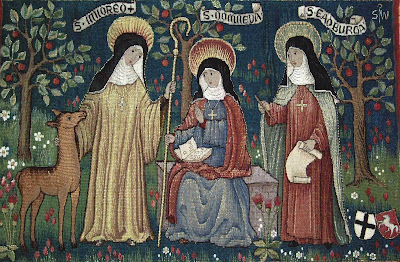
Tapestry owned by Minster Abbey, depicting the first three
abbesses, including Domneva and Mildrith

The remaining sister, Mildburg, became the second abbess of Wenlock, and many miracles were associated with her. 

An important document, the Testament of St Mildburg, speaks of land and gifts granted to her by her brothers, Merchelm and Mildfrith, although the language used suggests that they were her half-siblings (thus the assertion above that Merewalh married twice). In the Testament, Merchelm is styled rex but if he did, indeed, succeed his father as king of the Magonsæte the line stopped with him. Mildfrith was named regulus in a monumental inscription set up by Cuthbert, bishop of Hereford in the eighth century. Perhaps the brothers ruled jointly? The only other information we have of Mildfrith is a story concerning the murder of Æthelberht of East Anglia by Offa, king of Mercia. Apparently, upon hearing reports of miracles associated with the victim, Mildfrith founded a minster at Hereford. But Mildfrith must have been long dead by the time of this murder, which occurred in 794.The Testament does tell us though that his sister, or half-sister Mildburg, was still alive in 727, and possibly even in 736.

Plan of the later medieval buildings at Wenlock

Before she became abbess at Wenlock it had been under the auspices of the abbot of an East Anglian abbey and an abbess who came there from Chelles. As already mentioned, we know that Mildrith was educated at Chelles, and it is possible that Mildburg also spent some time there. A curious mix, then, produced a religious house in Mercia, on the Welsh border, founded initially by East Anglians and styled on Frankish models. 

It seems that Mildburg also had connections with Llanfillo, near Brecon; during the seventh century relations between the Mercians and the Welsh had been good – her grandfather Penda and Cadwallon of Gwynedd had fought as allies against the Northumbrians – so perhaps there is a possibility that Mildburg’s father Merewalh was indeed a Welshman, given land for service by Penda, or that perhaps he was Penda’s Welsh son-in-law, by dint of his first marriage, rather than his son. 

We don't know when, where or how Merewalh died (a date of around 680 has been suggested), and we have scanty information about his family, but his wife and daughters seem to have led eventful lives!

The name Magonsætan was mentioned as late at 1041, so it seems that some 'tribal' memory/identity remained centuries later.

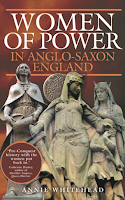
You can read more about Merewalh and his family in my nonfiction books, Mercia: The Rise and Fall of a Kingdom and Women of Power in Anglo-Saxon England. They also appear in my novel about Penda, Cometh the Hour, and feature prominently in the follow-up, The Sins of the Father. 


I've revisited the murder of Domneva's brothers in my new book, Murder in Anglo-Saxon England: Justice, Wergild, Revenge


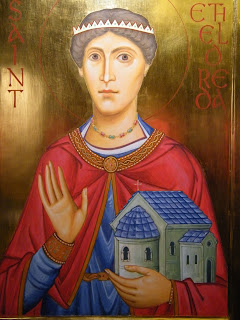
Monday, 7 March 2022

Great Escapes

 It's Women's History Month so it seemed appropriate to put together some stories about courageous women who most certainly did not submit quietly to a fate dictated for them by others:

Let’s turn first to seventh-century Queen Æthelthryth, a member of the East Anglian royal family but married to Ecgfrith of Northumbria. He was perhaps ten years her junior and, famously, she was said to have been encouraged by Bishop, later Saint, Wilfrid to remain celibate. Bede said he heard the details of the story from Wilfrid himself, and explained how Æthelthryth gained her husband’s permission to enter a monastery, staying first with Abbess Æbbe at Coldingham Abbey and then becoming abbess of Ely.

Image of Æthelthryth - with kind permission
 of the rector of Hexham Abbey

The Liber Eliensis (a history of Ely Abbey compiled in the 12th century) tells a dramatic tale in which Ecgfrith, having initially agreed to the divorce, tried to remove her forcibly from the convent. Æbbe advised Æthelthryth that her only option was to escape. The king set off in pursuit, but Æthelthryth and her two lady companions climbed to the top of a steep hill where divine intervention caused the water levels to rise, cutting off the hill and keeping the holy virgins hidden for seven days. The king could not get near, and eventually returned to York. Unfortunately the nuns on the rock began to suffer from extreme thirst. The abbess prayed for them and in answer to her prayers, a spring of water gushed forth and provided the nuns the means with which to slake their thirst. The Liber Eliensis states that this story was not based on the writings of Bede but came from those who knew the area of Coldingham and were witness to the events. Well, whether the story is true or not, she got to Ely safely and became abbess, being succeeded there by her sister.

A contemporary of Æthelthryth, Mildrith was the daughter of Merewalh (a sub-king of Mercia and possible son of King Penda), and Domneva (Domme Eafe) a Kentish princess. Mildrith was sent abroad, to be educated at the abbey at Chelles. Goscelin of St Bertin said that while she was there, the abbess attempted to force her into marriage with one of the abbess’s kinsmen. When Mildrith refused to comply, she was put in a hot oven, but miraculously managed to escape. The abbess then beat her so viciously that her hair was torn out. Mildrith sent some of this hair to her mother as an SOS signal. Domneva sent a rescue party, although Mildrith refused to leave until she had collected some holy relics from her room.

 The delay meant that they were pursued and were only successful in escaping because the tide turned. When she at last returned to Kent and set foot on land, Mildrith left the imprint of her shoe on the rock at Ebbsfleet and transferred to it healing powers. Mildrith entered Domneva’s house at Minster-in-Thanet and eventually succeeded her mother as abbess. This family was quite a force to be reckoned with. Though not involved in any dramatic escapes of her own, Domneva tricked a king, her cousin, who had ordered the murder of her brothers, into giving her the land where she built the abbey at Minster-in-Thanet. Incidentally, Minster Abbey is still home to a community of nuns. 

Tapestry showing the first three abbesses at Minster - with kind
permission from the community there

Osith,(alternatively Osgyth or even Osyth) was a relative of Mildrith’s, if she’s correctly identified as the the daughter of a sub-king of Surrey, Frithuwald, and his wife Wilburh, sister of King Wulfhere of Mercia (possibly Merewalh’s brother). According to later, twelfth-century, stories she was brought up in Aylesbury in the nunnery of her aunt St Eadgyth. On a journey to meet another aunt, St Eadburh, she drowned in the River Cherwell but was revived by the prayers of her aunts. She wanted to remain a virgin but was married off by her parents to King Sigehere of the East Saxons, but she avoided consummating the marriage, putting herself under the protection of a bishop named Beaduwine. (There are echoes here of the story of Æthelthryth, of course, who similarly was under the protection of a bishop). 

Sigehere seems to have accepted the situation and given her land at Chich, where she built her abbey. She thus escaped marriage, but perhaps not with her life, for she was apparently kidnapped by pirates and beheaded after refusing to renounce her faith. In one version of her story, she was buried at Aylesbury, while in another she was buried at Chich, taken to Aylesbury for nearly fifty years, and then returned. If Osith was indeed the daughter of Wilburh, wife of Frithuwald, then a connection with Aylesbury, a probable royal minster, makes sense. Her story might have been confused with that of another lady of the same name, because there were two feast days and one explanation is that the temporary relocation of the relics from Chich to Aylesbury was an attempt to reconcile two separate cults. 

Illuminated capital depicting Saint Osith

Let’s fast-forward now to the tenth century where we find a woman, sometimes a nun, sometimes not, sometimes a royal wife, sometimes not, but who, in one version of her story, also had a dramatic escape.

Wulfthryth was the mother of King Edgar’s daughter St Edith of Wilton, and possibly his son, Edward the Martyr. She became abbess of Wilton and was later venerated as a saint, but before that was the subject of much gossip. It is not known precisely when she took up the religious life. Some sources state that she was a nun when Edgar met and seduced her.

According to Osbern of Canterbury, writing in the latter part of the eleventh century, Edgar seduced a nun of Wilton who gave birth to a son, Edward. But another source, a young contemporary of Osbern’s named Eadmer, said that Edward was the son of Æthelflæd Eneda (Edgar’s supposed first wife). Eadmer decided therefore that Edgar, a married man, sinfully seduced a laywoman who wore a veil in an attempt to avoid the king’s attentions. He said that the king went to Wilton and, “captivated by the beauty of a certain young girl” ordered her to be brought to him while she, out of fear for her chastity, “placed a veil snatched from one of the nuns on her own head.” Edgar though, was not fooled and, saying, “How suddenly you have become a nun,” dragged the veil from her head.  

Goscelin of St Bertin said it was St Wulfhild, abbess of Barking, who was in fact the object of Edgar’s attentions. She evaded him by escaping naked down a sewer, and so the king took her kinswoman, Wulfthryth, a laywoman being educated by the nuns, instead. Goscelin was however adamant that Wulfthryth became Edgar’s lawful wife and that they were bound by ‘indissoluble vows’.    

Veils and sewers notwithstanding, Wulfthryth seems to have been a canny administrator of Wilton. She purchased a collection of relics, and lands which had been granted to her by Edgar were conferred to the nunnery, presumably so that the abbey would retain the lands after her death. She was influential too: Goscelin related how she brought pressure to bear on King Æthelred when his officers tried to remove a thief who had claimed sanctuary in the church and the royal servants were blinded as punishment, and how she interceded on behalf of two priests imprisoned by the reeve of Wilton.

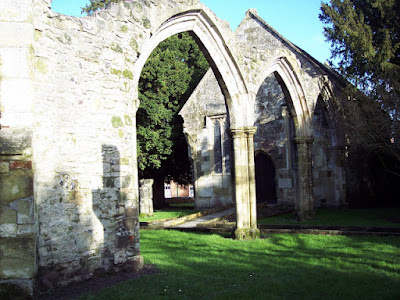
St Mary (Old Church) Wilton - attribution LINK

One of the escape stories has a less happier ending, though it’s not wholly one of despair. A woman named Cyneburh is named in the Gloucester Cartulary. According to legend, she was a Saxon princess who fled to Gloucester in order to avoid an arranged marriage. She took service with a baker, who was so impressed by her work that he adopted her as his daughter. This aroused the jealousy of the baker’s wife, who murdered Cyneburh. She then disposed of the body by throwing it into a well. When the baker returned home and couldn’t find Cyneburh, he began calling her name and she, though dead, answered him, thus revealing where her body was hidden. She was buried near the well, and a church was then built on the site. Thereafter miracles were recorded, with one woman being cured having lost the use of her muscles down one side of her body, another’s withered hand was restored, while someone else was cured of dropsy.

Sadly, it’s impossible to identify this lady. She is not Cyneburh daughter of Penda, for she married Alhfrith, son of Oswiu of Northumbria, nor is she Cyneburh of the West Saxons, wife of Oswald of Northumbria, who is generally assumed to have taken the veil at Gloucester and become abbess there. This lady of the well must either be a figment of the Gloucester chronicler’s imagination, or she is yet another woman whose full story might never come to light. 

I mentioned St Edith of Wilton briefly, and she has an escape story, or rather her leather and purple garments do (!) while Balthild the slave escaped servitude, and Judith of Flanders, having caused a scandal with her first two marriages, was locked up for her own good by her father and made her escape before marrying a third time. For more about those three indomitable women, see HERE


All these women’s stories are included in Women of Power in Anglo-Saxon England, and almost all of them feature in my novels, too.