Showing posts with label King Edwin. Show all posts

Sunday, 18 June 2023

Ad Gefrin - Anglo-Saxon Museum

 On Friday I had the opportunity to travel into ancient Northumbria to visit Ad Gefrin. A few years ago I had visited the site, at Yeavering, where an enormous 'Anglo-Saxon' hall had once stood (you can find my blog post about that visit HERE) so I was excited to hear news that in 2023 a new museum was opening just a few miles away, at Wooler. 
In April, Ad Gefrin Tweeted a selection of the books for sale in the shop, and I was thrilled to see one of mine included. A conversation ensued, during which I promised to let them know when I was planning to visit.

So now, let me tell you about my visit, starting with the website and booking tickets. It's maybe not essential to book in advance, though it would be advisable at busy times, and I was a bit concerned because though I didn't want to travel all that way and find it fully booked, I also - because of travelling such a long way - couldn't say exactly what time I'd be there. No need to worry though, because it's so simple to book your tickets online and know that the ticket gives you all day access, from 10am-6pm.

Off I went, tickets secured and, following another conversation via Twitter, knowing that the team there were ready to welcome me when I arrived. I'm afraid the first thing I did when I got there (in my defence, it wasn't my idea; I was encouraged!) was to sing into the 'atrium' and enjoy the resonance. I must say in apology to all who were there that I had given five talks in the week leading up to the visit and have not been to choir practice for a month so my voice was not at its operatic best!
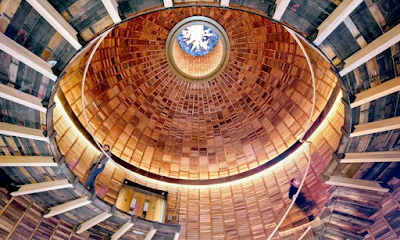
Upstairs I was welcomed into the mead hall, (and asked to leave any weapons at the door)

and it was explained that there was an audio-visual to watch. I imagined the usual run-of-the-mill VT scenario, and I couldn't have been more wrong. The auditorium makes up an imagined half of the great hall, while the audio-visual presentation makes up the other half. It is an extraordinary presentation and does an incredible job of bringing the Anglo-Saxon hall to life. Various characters stepped forward to speak, and explain who they are and talk about their lives. It was mesmerising (though not easy to photograph, so apologies for the picture quality):

I was told that on the dais where there are three beautiful wall hangings there will soon be two replica 'thrones' so that's all the excuse I need to return for another visit. 


Here are some pictures of the other half of the hall where you can sit and enjoy the audio-visual show:


In the other half of the museum you can see the display of artefacts, some unearthed nearby and some on loan from the British Museum and other places:


as well as site plans and models of the buildings:


I was so intent on scrutinising the exhibits that it was only as I made to leave that I fully noticed the paintings behind the displays, and spent a long time looking at them and appreciating how much they helped to contextualise the exhibits:


Of course, me being me, I chatted at length to the staff who were all knowledgeable and friendly. Downstairs again, I had another long chat with the team, and accidentally found myself purchasing a bottle of gin from the distillery... I didn't have time to do the distillery tour so again, that's another excuse to go back again...


The museum has only been open for three months or so and already it is a stunning place and it will continue to grow and develop. What I especially loved is how immersive it all is and how, without fanfare or fuss, it opens a window onto life in an Anglo-Saxon 'court'. The artefacts are well presented, easy to see and with easy to read notes. The backdrops add visual aids which really help to imagine what life looked like and the colours and detail are rich. Anyone who thought that early medieval buildings were drab wooden sheds will leave with an entirely different impression after looking at the intricate and beautifully decorated carvings in the 'hall'. Similarly, anyone who thinks that the clothing of the period was drab, plain, and unadorned will watch the film and discover that's simply not true.

There are dots to be joined up too: in one of the display cases there is a shield boss


which is, frankly, stunning enough. But back in the hall, you can see a replica of how this shield would once have looked:


I think it's so important to present history in this way; to give an insight into how that world looked. While I was there I noticed that many of the visitors were prompted to ask questions about what they were seeing, and came away having learned even more about the importance of the site at Yeavering, the history of the Northumbrian kingdom, and the Anglo-Saxon world.

I cannot recommend Ad Gefrin highly enough. Do visit if you can.


Find Ad Gefrin on Twitter and Instagram


Tuesday, 20 February 2018

Yeavering – Anglo-Saxon Royal Palace

“So great is said to have been the fervour of the faith of the Northumbrians and their longing for the washing of salvation, that once when Paulinus came to the king and queen in their royal palace at Yeavering, he spent thirty-six days there occupied in the task of catechizing and baptising.” (HE II 14*)
The king in question is Edwin, seventh-century king of Northumbria, and the queen is his second wife, Æthelburg of Kent, known, according to Bede, by the nickname ‘Tate’.

Paulinus is said to have baptised people in the river Glen, which runs alongside the site of the palace. Visitors to the site will still be able to see the river, but of the palace, there is not a trace.


The view across the site towards the river

Archaeology has revealed that Yeavering at the time of Edwin’s reign was a magnificent royal vill. But Edwin didn’t build it. Rather, he rebuilt it.

What were Edwin, his wife, and the holy man Paulinus doing there? After all, it’s a forbidding place, surrounded by the towering Cheviot hills, windswept and desolate.


Edwin was technically the brother-in-law of the previous king of Northumbria, Æthelfrith, whose son, Oswald, was born to him by Edwin’s sister. Although in those days Northumbria was two distinct kingdoms, Deira (centred around York) and Bernicia (centred around Bamburgh), dynastic squabbles and bloody feuds meant that, periodically, one man ruled over both kingdoms.


The English kingdoms c. 600 (public domain image)

In the seventh century, kings were gradually converting to Christianity.  It was no quick decision, and usually had some political element to it. Edwin was not about to make a spur of the moment conversion. The site of Yeavering was significant because it was in an area previously ruled over by Edwin's nemesis, Æthelfrith. Would conversion bring more power?

Edwin procrastinated, so much so that Pope Boniface wrote to him, and also to Edwin’s wife. Æthelburg was the daughter of Æthelberht, the Kentish king whom Augustine had converted, and a sister of Eadbald, the reigning king of Kent. When he wrote to her, Boniface urged her to bear in mind her Christian duty to evangelise, and included with his letter a gift of a silver mirror and a gold and ivory comb. To Edwin, he hinted that he would, by converting, put himself on an equal footing with the powerful king of Kent. This must have been quite an inducement.

Edwin evidently grasped what was expected of him, and offered a compromise – he expressed his willingness to convert if his advisers agreed, and undertook to place no obstacles in the way of missionary endeavour. He also offered a promise that took account of the position of Æthelburg, for he gave assurance that she and her retinue would be free to practice their own religion.

Paulinus, who travelled with ‘Tate’ from Kent, ‘bagged’ Edwin’s all-important royal soul, thus, according to Bede: when Edwin had been in exile in the court of Rædwald of East Anglia, an apparition came to him, promising him a kingdom, and salvation, if he would but remember by whose word this promise would be fulfilled. Paulinus now revealed himself now as the apparition by whose power Edwin had gained his kingdom. (HE II 12)

When the king and queen had produced a daughter, Eanflæd, Edwin was persuaded to allow Paulinus to baptise her in thanksgiving for his wife’s safe delivery.

Yeavering lies in what was the kingdom of Bernicia, forty miles north of Hadrian’s Wall, and about twenty miles inland from the great fortress of Bamburgh. It is a desolate and often a very cold place. Bede describes it as a royal vill, (town) and talks about the work of Paulinus there, but he also tells us that at some time later it was abandoned. Perhaps the archaeology and the history can be linked?


The site, showing the modern wall at the roadside

In 1949 an aerial photograph showed the marks of extensive buildings there, and the site was then excavated by Dr Hope Taylor.

He found that as a place of burial, Yeavering had a long prehistoric past. A big and seemingly elaborately defended cattle corral is likely to have gone back to the days when the area was ruled by British, not English, kings. Hope Taylor also discovered a series of buildings dating from the end of the sixth century to somewhat later than the middle of the seventh, corresponding to the reigns of Æthelfrith, Edwin, and Oswald.

Among the most important were a succession of halls. The largest, which he concluded was probably Edwin’s, was over 80 feet long and nearly 40 feet wide. Its walls were likely made of planks, 5 ½ inches thick. The fact that the post holes showed that timber were set up to eight feet into the ground, suggests that the walls must have been very high. There may have been a clerestory (a high section of wall that contains windows above eye level, with the purpose of letting in light, and/or fresh air). Its successor, probably dating to the reign of Oswald, Edwin’s nephew and successor, was equally grand.


Yeavering - digital 'fair use' image. (Attribution)

More remarkable still was a kind of grandstand, (top left of above image) shaped like a segment of a Roman amphitheatre, which stood facing a platform. When first built, possibly under Æthelfrith, it had accommodated about 150 people; later, perhaps under Edwin, it was enlarged to hold about 320.

It has been agreed that its only purpose can have been for meetings; and of a kind where one man on the platform, presumably the king, faced many. Perhaps it was here that Edwin consulted his amici, principes and consiliarii on the adoption of Christianity (though this debate more probably took place in York, where Edwin finally received his baptism.)

Yeavering in its heyday would have stood as a symbol of the might and power of Edwin, who, as one of the named ‘bretwaldas’ (overkings) in Bede’s list, wielded considerable power. A prince of Deira, he would have known the importance of establishing his authority across Bernicia, and building over the remnants of his predecessor’s hall.

And yet, the royal buildings at Yeavering were not fortified. Perhaps they should have been; there is evidence that the palace was destroyed by fire, not once, but twice, and the dates coincide with Bede’s records of Mercian incursions into Northumbria.

Additional finds included what may have been a pagan temple later converted to Christian use, and a building which might have been a small Christian church.


Yeavering, though a major centre for Bernicia, was by no means the only such centre these kings possessed. There was another, much more important, at Bamburgh, and other royal vills scattered through their kingdom, many of which may have had halls as grand. But the wonderful thing, for historians, is that we have the evidence for this one, even though there is now no trace of these once impressive and imposing buildings. To stand in this enormous field, (and it is a huge site) gazing out over the waters of the river Glen, and know that here stood the people whose lives I have studied, and written about, for years was, even on that very cold and blustery day, really quite moving. So little of Anglo-Saxon architecture remains, but thanks to Dr Hope Taylor, and to Bede, at least we know what once was here.

As to why it was, as Bede tells us, abandoned, well that remains a mystery, and one which neither the archaeology (which suggests 655, a time of Northumbrian supremacy) nor the history seem able to solve.

[*Bede's Ecclesiastical History of the English People]
{This post originally appeared on the EHFA Blog on 22/9/17}
(All photographs taken by and copyright of the author)

Find me on Amazon

Recent Posts:
The Battle-site of 'Heavenfield'
Repton - Royal Mausoleum and Viking Stronghold
The 'Evil' Women of Mercia
Anglo-Saxon Childhood
Reaching Across the Centuries

Tuesday, 23 January 2018

The Battle-site of 'Heavenfield'

Someone asked my - adult - daughter once if I travelled to many locations in the course of my research. Her answer was: 'She stands around in fields a lot and gets emotional, does that count?'

Well, it's largely true. There are a few buildings that can be dated to the Anglo-Saxon period (see my post here about Escomb Church) but when it comes to battle fields, many are still missing, presumed lost. 

While historians continue to argue about the exact location of Brunanburh, there are some sites which are less disputed, one of which is the place where, before the battle at Heavenfield, Oswald ordered a wooden cross to be erected, and it could be the site of the ensuing battle, too. It's where St Oswald's Church now stands, close to Hadrian's Wall. So close, in fact, that there are bits missing from the wall at this point, and it's thought that stones from it were used to build the church.


What we know of the battle is this:~

Edwin, king of Northumbria, had been killed in battle in 633 by the combined forces of Penda of Mercia and Cadwallon of Gwynedd. According to Bede, (HE ii 20) Cadwallon was in rebellion against Edwin, suggesting some sort of overlordship, evidently resented, and after the battle the land of the Northumbrians was ravaged and Edwin's wife and surviving children fled to Kent.

Edwin had been expanding his kingdom at the expense of the British kingdoms, and while there are some traditions which suggest that initially Penda of Mercia and Cadwallon had been enemies, they were at this point in alliance, although there is some debate over whether it was an enterprise of equals, or whether Cadwallon was the leader. 

Edwin had been in exile for many years before he became king, and one of his first acts upon gaining the throne had been to attack the British kingdom of Elmet (centred around modern-day Leeds) and in so doing, he removed a 'buffer' between his own lands and those of the Welsh.

After Edwin's death, the kingdom of Northumbria briefly split back into its two separate kingdoms, and Edwin's cousin came forward to claim Deira in the south, while an exiled member of the old ruling dynasty claimed Bernicia in the north.

Cadwallon, who clearly had a hefty axe to grind, killed the former, who had 'rashly' tried to besiege him, and a year later, also slew the latter, who had come to make peace with the Welsh king bringing 'only twelve chosen thegns' with him. Bede's verdict was that Cadwallon had executed a 'just vengeance on them, though with unrighteous violence'. They had, he said, reverted to the 'filth of their former idolatry'. (HE iii 1)

The latter's half-brother, Oswald, had also been in exile, and returned now to claim both the kingdoms of the north. Oswald was also the nephew of the previous king, Edwin, and having both Deiran and Bernician blood, was acceptable to both realms. There was just the small matter of the Welshman - a Christian whom Bede called 'a barbarian in heart and disposition' who spared neither women nor innocent children' - to deal with...

Oswald came, according to Bede, with an army, small in numbers but strengthened by faith, and I imagine that they might have followed the line of the wall as they travelled from what is now the west of Scotland. Before the battle, Oswald is said to have set up a holy cross, and it is on this site that the present church was built.


Excavation at this part of the wall has revealed fragments of human bone and weaponry, suggesting that this is indeed the site of a battle.


The church sits on top of the hill, and as I stood in the churchyard and looked down at the fields below, I couldn't help but picture the landscape as it might have looked then, with soldiers and equipment.


Cadwallon was slain. Possibly his forces were depleted, for it seems he had been campaigning in the north for a while. He is said to have been killed at a place called Deniseburn which has been identified with Rowley Burn*. If so, then he was chased for some miles before he was killed. I drove to Rowley Burn, and tried to envisage what it must have looked like in 634, when a mighty Welsh king drew his last breath, but the scene was a tranquil one.


Of the site of the church, Bede said that it was a place still 'held in great veneration' (HE iii 2) but no trace of the Anglo-Saxon church remains.  Inside the existing church, which dates from the nineteenth century, there is a Roman altar stone,


and the building is peaceful, simply presented, and so calm and quiet it's hard to imagine the clamour of battle which once rang out. 


Given the location and the archaeological evidence, I feel confident that I was in the right place. It's not often that I can stand somewhere and know that the people I write about once stood in the same spot. So yes, I do often stand in fields and get a bit emotional.


These characters all feature in my latest novel, Cometh the Hour

[all photographs by and copyright of the author]

* Peter Marren, Battle of the Dark Ages, pp74-75