Showing posts with label Sutton Hoo. Show all posts

Sunday, 14 December 2025

On 'location'...

I often quote my daughter who once said, when asked what I do, that I “Stand around in fields getting emotional.”

Well, if your interest is pre-Conquest England, there’s nothing left to see of that period but empty fields, right? Wrong. Yes, it’s true, I do spend a lot of time in fields, but it is possible to visit sites connected with Anglo-Saxon England, and I thought for this post, my last of 2025, I'd take you on a whistle-stop tour of some of the places I’ve been where I’ve felt a real connection to the people whose stories I write, with some links for further reading if you'd like.

I’ll start with some buildings - yes, actual buildings. The main reason there’s so little of Saxon England left to see is that they mainly built with wood, which hasn’t survived. But religious buildings, especially in the later part of the period, were built in stone. And there are some beautiful examples still standing.

Escomb

Sitting these days rather incongruously surrounded by modern housing in a little village in County Durham is this extraordinary Church. It probably dates from the late seventh century, and it recycled some Roman stone. It has a wonderful sundial on the wall outside and, apart from the porch - a new addition - has survived intact and unmodernised, probably because the rich bishops of Durham lost interest in it and it was never extended. (See a post all about Escomb HERE)

St Oswald’s, Gloucester

Not far away from Gloucester Cathedral are the remains of St Oswald’s priory. It was originally dedicated to St Peter, but if you know your early medieval history or have read my novels Cometh the Hour and To Be A Queen, you’ll know what happened to Oswald of Northumbria and that his remains were fetched to Mercia by Æthelflæd, Lady of the Mercians. It wasn’t the first time he’d been posthumously re-homed though, as you’ll discover in my latest novel, The Sins of the Father. Æthelflæd herself was laid to rest here, next to her husband. This isn’t a field, and there's not much left of the building, but I did get incredibly emotional standing on this site and feeling so close to the people about whom I’ve researched and written so much.

Deerhurst St Mary’s and Odda’s Chapel

Visit Deerhurst, also in Gloucestershire, and you get a real two-for-one. Parts of St Mary’s church are the original Saxon building and, again, if you’ve read To Be A Queen I can tell you that this is the chapel where Ethelred goes to pray, where he takes Æthelflæd, and where they sit together in his twilight years. When I visited, I had the place to myself and the sense of calm was overwhelming. It’s still a working church and the connection with the past is almost palpable. In the book I mentioned the carving of the Madonna above the door, and the ‘angel’ on the outside wall, and here are my photos of them.


Less than a stone’s throw from the church is Odda’s Chapel. Odda was a later earl of Mercia who, despite the assertions of some guide books and websites, was not related to Earl Ælfhere, or Alvar as I called him in my novel, Alvar the Kingmaker. He built the chapel in remembrance of his brother and the dedication stone reads: 
"Earl Odda ordered this royal hall to be built and dedicated in honour of the holy Trinity & for the soul of his brother Ælfric who died in this place. Bishop Ealdred dedicated it on 12 April. The fourteenth year of Edward, king of the English (1056)." 
The chapel would not have been discovered had a tree not fallen down in 1675 and revealed this stone embedded in its roots. Even so, the chapel was not discovered until the nineteenth century during renovations to the manor house attached to it.  

Hexham


Just a quick word about this: if you visit Hexham Abbey be sure to go down to the crypt which dates from the days of St Wilfrid (c. 633 – 709 or 710) who features in both my Tales of the Iclingas novels, Cometh the Hour and The Sins of the Father. And try, as I did, to spend a few moments alone down there. Incredible. (Read more about this and another of Wilfrid's crypts HERE)

But perhaps I should take you to some of those fields now?

Yeavering


It’s bleak. Even centuries after the settlement was built, the site sits in open countryside, surrounded by huge hills, and a fierce wind blows. Not the obvious spot for a ‘des res’ (desirable residence) but nevertheless it was here that Edwin of Northumbria decided to build (or rebuild; there’s evidence that this site had been in use during an earlier period) a great hall, and excavation has shown that there was also some kind of outdoor ‘amphitheatre’, probably where meetings were held. Bede tells us that Bishop Paulinus baptised Northumbrians in the nearby River Glen. All I can say is that they must have been freezing. Still, standing on this enormous site, hemmed in by the hills of the Cheviots, I felt a connection with the man who plays a major part in Cometh the Hour. (Read more about Yeavering HERE)

Heavenfield


Still in Northumbria, my next ‘field’ is Heavenfield. It’s where Oswald, he whose remains have travelled up and down the country, was said to have erected a wooden cross on the eve of battle. He was Edwin of Northumbria’s successor, though these men, despite being uncle and nephew, had never met. There’s a church on the site now, a site which may also have been the battlesite, for excavation has revealed fragments of human bone and weaponry. It’s an atmospheric place, but for me even more poignant was the place we managed to track down nearby, Rowley Burn, which is probably the Denisburn which Bede spoke of as the place Cadwallon of Gwynedd made his last stand. Cadwallon was a good friend and ally of Penda of Mercia and while writing Cometh the Hour I developed a deep affection for him. To be so close to the place where he fought for his very life was moving indeed. (Read more about Heavenfield HERE)


Sutton Hoo


Back down south now, and one of the most famous fields of all (aside from the one just off the A5, where the Staffordshire Hoard was discovered, the subject of my last blog post).  In 1939, when Great Britain was on the brink of war with Germany, a lady named Edith Pretty asked a local amateur archaeologist to investigate some mounds on her property which she was convinced were burial mounds. Well, I think we all know what happened next, and the unearthed ship burial with its incredible wealth of treasure is world famous. I visited this Suffolk site early one morning, just as it was opening. Coachloads of people had also just arrived, but I noted that they were all heading initially to the visitors’ centre. I made my way swiftly to the site itself, and thus was alone with the burial mounds. Never mind that one - the big one - is now a reconstruction; I stood for a moment in the early morning light on that summer’s day and felt a chill.

Yes, I seem to do a lot of ‘standing around getting emotional’ but when you’re so close to the past, it’s hard not to.

[All photos by and copyright of Annie Whitehead]

Tuesday, 7 December 2021

Adding some Atmosphere

I've had some lovely compliments recently about the world-building in my novels, so I thought I'd share some aspects of 'Anglo-Saxon' life here with you today.

In my novel Cometh the Hour, I imagined the Sutton Hoo burial and mentioned the lyre that was included in the grave goods. But in all my novels, I've written scenes set in the mead hall during a feast, where invariably there is a scop telling tales, riddles, and playing music.

My photo of the reconstructed lyre at Sutton Hoo

Here's a link (the image of the inside of the mead hall is not strictly accurate) to a piece from Grendelcynn on Youtube, played on a similar instrument. It will give a flavour of the kinds of sound one might have heard at the time:

https://www.youtube.com/watch?v=2_GVjcVBiP4

Of course, lyres weren't the only musical instruments. There were also wooden and even bone whistles, or flutes. The Malham Pipe was originally thought to have been Bronze Age, but is now thought to be post-Roman, and it might have sounded something like this:

https://soundcloud.com/pittriversound-1/malham-pipe-jig-eric-todd-1951

I'm very lucky in that the Thegns of Mercia specialise in reconstructing the earlier 'Anglo-Saxon period'. They are constantly inspiring me, and if you've read Cometh the Hour and/or the follow-up, The Sins of the Father, and want an idea of the wrap-over coats that my characters wear, well, here's an image, with kind permission from Æd Thompson and with credit to Jon Wylie of the Thegns:


Please do visit their site or catch them on Twitter and Facebook for more wonderful photos and reconstructions.


Of course, we all know that people at this time loved their 'bling'. Those who've read 'Sins' might recall that a Kentish bride was wearing a rather lovely, and rather large, brooch. My inspiration for this piece was the Kingston Brooch which, I think you'll agree, is also rather lovely:

Image via Wiki Commons: Link

This has been dated to the seventh century and was found near Kingston in Kent, so I'd say it's a pretty perfect fit for my seventh-century royal Kentish bride to wear on her wedding day!

Sadly, there are no surviving examples of Anglo-Saxon wooden buildings, but to get a sense of what they looked like, you could do worse than visiting West Stow Anglo-Saxon Settlement, where they have examples of various styles of buildings:

Via Wiki Commons - Link

There are a few surviving stone churches, however, and whilst it's fair to say that in the early conversion period the churches were also built of wood, there is a remarkable stone built church which has been dated to around the time that my main character in The Sins of the Father, Ethelred, became king of Mercia. This one is in Northumbria, land of his enemies, but let's not hold that against this beautiful building, which I was lucky enough to visit in the spring when the blossom was out:

My photo of Escomb Church, Bishop Aukland, Co Durham

So these are some of the sights, but what about the sounds? The characters in my books would all have spoken local dialect versions of Old English, which sounds like a language far removed from our own, but there are lots of recognisable words, if you look closely.

I wrote a post a little while ago, looking at the words of the Lord's Prayer, and how we can decipher some of the Old English words. 

The Lord's Prayer in Old English - written 
for me by calligrapher, reenactor, and friend,
Dawn Burgoyne

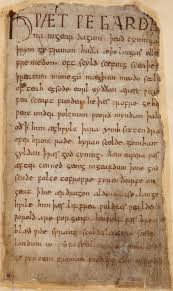
However, perhaps to get a flavour of the seventh-century mead hall we'd be better off listening to a lovely reading of the epic poem Beowulf - which might have originated in Mercia! - by Heiðniborg:

https://www.youtube.com/watch?v=7CpKlEiahtI

A page from a copy of Beowulf

Outside the mead hall you'd hear various sounds, none louder than thunder. Animals, the clanging from the forge, and conversation (in Old English, of course). Whilst putting together this little blog post I came across this fun website. It's a bit too 'modern' for our purposes, but I reckon if you set the sounds to this pattern, you'll get an idea:

Click HERE to visit the site

Of course, one thing I can't do is bring you the smells of Anglo-Saxon life. In my books, I try to focus on the more pleasant aromas - cooked food, flower blossom, herbs - but I'm sure you don't need me to tell you that some other smells might have been distinctly unpleasant, so perhaps we should be grateful that blog posts can't yet bring Smell-0-Vision to the world!

My two-book series, Tales of the Iclingas, is complete and available now:

Cometh the Hour:


The Sins of the Father:


And you can find my other novels, stories, and my nonfiction books HERE


Monday, 11 December 2017

Anglo-Saxon Music

Over the course of this year I've invited a number of authors to write about the music that inspires them, either to write, or while writing. I suppose it's now time for me to do the same!


Some of the authors chose music which came from the period in which their novels are set. It's not so easy for me to do this, as my writing is all set in the pre-Conquest period. I do have a CD, however, which attempts to give the flavour of the music of the time, and it can be quite useful for creating atmosphere.


Sanctus seeks to recreate the sounds with which Bede might have been familiar, taking traditional plainchant and adding harp and pipe.
Factor est cum Angelo
It's fair to say, though, that this is probably not a true representation of the music of the time. Few musical instruments have been unearthed from this period, possibly because they were mainly made from wood. Flutes made from applewood and hawthorn were unearthed from the Anglo-Scandinavian levels at York [1] but where the soil composition is not so conducive to the preservation of such items, they will have been lost. The sound would be more sonorous than those made of bone:
Sheep Bone Flutes (Youtube)
Some flutes were also made from the bones of swans' wings.

The other main musical instrument that we know about is the lyre, referred to in the sources as the harp. The most famous of all these finds is probably the Sutton Hoo lyre, but it is rather more ornate than those which would have belonged to a 'jobbing' musician, or scop. It was made from maplewood, and had six tuning pegs. The sound board was secured using pins cut from a strip of sheet copper alloy [2]
Anglo-Saxon Harp (Youtube)
The highest level of woodworking skills were required to make the instruments. A lyre has two main elements, the sound-box and the yoke into which the tuning pegs were seated. The lyre at Sutton Hoo had a 16mm deep soundbox carved from a single piece of maple. The soundboard, 3mm thick, was nailed over it, and the joints used to fix the yoke to the arms of the sound box were 'bridle joints', not 'mortise and tenon' [3]


Replica Lyre at Sutton Hoo - authors' own photo

Scops, the poets and singers, would have played the harp, but it seems that others were expected to have playing skills, too. Important occasions were marked by feasts, accompanied with music and entertainment. According to Bede, "When a cause for celebration had been determined ... they must all sing with a harp in turn."

However, stage fright appears not to be a modern phenomenon. "Whenever all those present at a feast took it in turns to sing and entertain the company, he would get up from the table and go home directly he saw the harp approaching him." [4]

Another instrument was the handbell, made from iron and primarily used for cows, but also used by Irish monks in the early Christian period. The figures below are depicted at Edward the Confessor's funeral (Bayeux Tapestry)


Much mention is made of the power of song. "That every day he heard the pleasure loud in the hall, the scop's clear song." (Beowulf 1.86-9)

It seems that there were different types of song: giedd (narrative and often sad), the leoð (also narrative), folcræden (tribal tradition) [5]

It's possible that as well as being played and sung in the hall in the evening, the scop's music was also used to rouse the slumbering warriors the morning after - a precursor to the alarm clock!

It's clear that music, and particularly song, was important. From Widsiþ:
...and I with a bright voice, raised a song for our victorious lord. Loud with the harp the sound mellowed, when many men, proud with mead, spoke their words,who well knew, that they had never heard a better song."

 We can't be sure what any of this music sounded like, but we have a little information dating from the end of the period. The Winchester Troper dates from around AD1000 and includes possibly the oldest written music, designed to be performed in Winchester Cathedral. A sample can be heard on YouTube.


Winchester Troper


Here's a recreation of what multi-instrumental music might have sounded like:
Anglo-Saxon Folk Music - "Wælheall"

and a demonstration of music played on replicas of instruments found together as grave goods.
UR Pipes & Lyre

The theme of this series of blog posts has been Writing to Music. For all the reasons stated above, it's hard for me to do this in the way that some authors can. If music inspires me, it's usually the lyrics which spark my imagination. Lyrics, for me, are a bit like the poetry of Tennyson: an elegant yet simple summation of the things we all feel, but struggle sometimes to put into words. Songs often dig down and expose the centre of my characters' situations. If you've read my books, then you'll know who I'm talking about:

Chasing Cars - Snow Patrol: sums up how Æthelred of Mercia feels when he's tired of the struggle and wants his wife to just be with him, supporting him. (To Be A Queen)

You're Beautiful - James Blunt: simply  a perfect way to describe how Alvar feels when he first meets Káta. (Alvar the Kingmaker)

Leaving the Land - Mary Black: a wonderful expression of Káta's belief that you can't go forwards in life if you're always looking behind you. (Alvar the Kingmaker)

I can't make you love me - Bonnie Raitt:  a pivotal moment in the lives of Edwin and Carinna. (Cometh the Hour)

Angel - Sarah McLachlan: this track happened to be playing while I was writing one of the saddest scenes of Cometh the Hour. If you've read it, you'll know.

None of these tracks is remotely medieval in sound. But emotions are timeless, aren't they? However, there is something which bridges the gap between authentic Old English music, and the atmosphere conjured up by those artists and writers attempting to recreate the past. So, finally, enjoy this video and the accompanying music.
Wedding (Wardruna)
Amazon Author Page

[1] Wilson, 1976, (Quoted in The Mead-Hall - S Pollington)
[2] [3] Anglo-Saxon Crafts - Kevin Leahy
[4] Cædmon's Vision, Translation by Kevin Crossley-Holland
[5] Bloomfield & Dunn 1989

Sunday, 2 August 2015

Culture, Language and amateurish Romans ! Old English Specialist and Author Stephen Pollington casts some light ...


Today I have the enormous pleasure and honour of speaking to Stephen Pollington:

steve

I asked him -

You grew up in what was then countryside - was it idyllic, and how old were you when you were first aware of 'history'?

The presence of the past was part of the backdrop to everyday life from a very early age. Saturday mornings were spent with friends in the local cinema (which was still painted with WWII camouflage!) followed by the mandatory trip to the nearby site of a motte-and-bailey castle where we acted out the key events from the films we had just seen - most often westerns, wartime thrillers or historical dramas.
My strongest recollection is of being impressed by the age and size of a church tower that stood on the hilltop above my grandparents' home - compared to the humble dimensions of my house it seemed immensely tall and sturdy, and being made from stone - in Essex, where the soil is mostly clay - it struck me a s a strange structure, a relic of a time when all the effort and resources it took to build it could be concentrated on such a project.

image by oneblackline

What were history lessons like at school - did they nurture or stifle your interest? (People's experiences of school history lessons vary so widely and I wonder what periods you were taught about and whether it fired your interest)

History was taught as a narrative back then - it was a LONG time ago - with a focus on key events and personalities, and an unspoken theme of human progress as the underlying assumption. This was in the days of the 'Space Race' in the 1960s when the nation was encouraged to look to the future and ignore the past - Thunderbirds and Dr Who were the key items of children's TV viewing. History in school was used as a means of explaining how we got to where we are now, with the assumption that the future would be better, cleaner, healthier and more affluent. I am still waiting for my jet-powered skates and three-course meal in tablet form.
I always enjoyed formal lessons with a specific theme and I think they awoke in me an urge to share my own (flawed) understandings with others.

Image from blastr.com

You obviously have an abiding love for the Anglo-Saxon period. It's perceived though as not 'popular' - do you think we English have a problem connecting with our past? (The Irish, Scots and Welsh don't feel the same - have we lost sight of our own heritage somehow?)

The Anglo-Saxon period gave rise to the modern nations: there was no 'king of all the English' before Athelstan in the mid 10th century. But you are right - it is no longer popular perhaps because the height of its popularity coincided with the period of Victoria and Albert. After the First World War, opinions of things 'German' nosedived, and after the Second World War the situation got a whole lot worse. The extent to which the historical 'Saxons' have anything to do with the more recent German political unit of the same name is usually ignored.

History-of-The-Anglo-Saxons-by-Sir-Francis-Palgrave-1998-Paperback
Palgrave's book was first published in 1831

I think we have been encouraged to downplay English history in favour of the inclusive term 'British' while simultaneously celebrating the Irish, Scots and Welsh. This leaves people confused at to where the English fit into this picture. Even the name 'Anglo-Saxon' creates the impression that these were a foreign people, not really 'English' at all.

You are fluent in Old English. How easy was it for you to find the resources you needed to study the language?

As a young man it was very difficult to find the resources, especially in a small market town. But I was always a bit of a language-nerd and haunter of the public library. I studied not just individual languages but began to see the relationships between them - in the way that even a basic knowledge of French can help you recognise words in Italian or Spanish, poulet and pollo for example.
In my early teens I acquired a second-hand book on Old Norse and began to study that language with great enthusiasm. Further purchases provided an insight into Old English. I bought a worn copy of Beowulf which someone had heavily annotated in pencil, and that set me off on a voyage of discovery from which I have never ceased.

How important do you think it is to keep the language 'alive'? Is it a difficult language to learn, in comparison, say, to learning Modern English as a foreign language?

It rather depends where you start from. If you are a native speaker of English, Dutch or German a lot of it is very familiar and things that are puzzling in modern English start to fall into place - the relationship between 'old' and 'elder', 'slow' and 'sloth' or 'steal' and 'stealth', for example. Most of the basics of Old English are still present in the modern language, despite the vast influx of Greek, Latin and French vocabulary. When Neil Armstrong stepped out onto the surface of the moon, his immortal words, 'One small step for a man, one giant leap for mankind' are all taken directly from the language that King Alfred used in the 9th century.
Without a detailed understanding of its history, a full appreciation of the modern language is not possible. This applies as much to words introduced in relatively recent times as to those with roots stretching back millennia.
A few talented people who may have no formal training instinctively know which words fit together - we call them 'poets'.

This blogger used Sweet's when she was a student!

Are there any common misconceptions about the Anglo-Saxons which you'd like to take the opportunity to correct?

If you watch TV dramas, Hollywood films or other superficial forms of entertainment, you quickly find two standard stereotypes for the Anglo-Saxons. The first is of marauding warriors with no organisation or loyalty whose sole aim is to despoil and destroy. 
The second group are the downtrodden serfs who lost the battle of Hastings and are forever destined to be cannon-fodder for their social superiors. These 'Saxons' all wore brown sacks for clothing, lived in mud huts and were covered in soot, soil and sticky stuff and had only a rudimentary grasp of any skills or crafts.


Image from luckinlove.com
Both these portrayals leave me exasperated because they are the inventions of lazy media people who are too self-obsessed to do any actual research - you know, reading a book or looking at some artefacts, or just asking someone who might know a little about the period.
Anyone who has seen even photographs of the best-known material - such as the finds from Sutton Hoo, the Staffordshire Hoard, the Lindisfarne Gospels, the Alfred Jewel, the Franks Casket - cannot fail to be impressed by the quality of the workmanship and the skilful combination of a variety of materials into a unified and beautiful object. Then look at the range of books the Anglo-Saxons produced in their own language - everything from detailed laws and land charters to translations of Roman and Greek religious texts, chronicles, medical books, poetry, legends and rude jokes - they are all there.
Look at the garnet and gold wargear from the Staffordshire Hoard and explain to me in what sense this was 'the Dark Ages' - it was a Golden Age when some of the finest decorative items produced north of the Alps were put together. Bear in mind that Anglo-Saxon goldwork could not be replicated to anything like the same quality as the originals until the 19th century. No doubt I will get into trouble for saying this, but a lot of the allegedly superior Roman and medieval material looks pretty amateurish by comparison.

Gold belt buckle
The Sutton Hoo Gold belt buckle - image from the British Museum
Are there important lessons to be learned from studying the Anglo-Saxon period?

All history is important and should be instructive. The Anglo-Saxon period laid the foundations of our social structure, our language, our political organisations and to a large extent our identities. As with the language mentioned above, if you don't understand how modern counties came into being and what they replaced, you will never fully understand modern British political geography. A knowledge of the effects of the Norman invasion is no bad thing either, if you are interested in social structures and elitism.

Can you sum up why you love the Anglo-Saxon history, culture and language so much?

It is the beginning of so much that we take for granted: many of our warmest and most powerful words, our ideas about family and society, our regional identities, the framework by which our lives are lived. To me, that is endlessly fascinating.


Thanks to Stephen for his insights. To discover more about him and his work:

Wordcraft ~ The English Warrior ~ First Steps in Old English ~ Meadhall - Feasting Tradition in Anglo-Saxon England ~ Leechcraft - Early English Charms, Plantlore and Healing ~ Rudiments of Runelore ~ Anglo-Saxon Burial Mounds ~ Anglo-Saxon FAQs ~ Wayland's Work – Elder Gods – The Sutton Hoo Stone