Wednesday, 9 August 2017

Administration in the Reign of Charlemagne

You know me, I like trawling through old documents – and the other day I found one of my own (I’m over fifty, therefore I am part of history!) This is the write-up of a paper I delivered many years ago, back when I was still a teenager. I've recently been re-visiting the reign of Charlemagne and looking again at the letters of Alcuin, exploring the relationship between Charlemagne and Offa of Mercia. Here though, it seems the task was to talk about administration in the reign of Charlemagne (Charles). 

Royal Courts

In the seventh and eighth centuries, the Lombard kings had a palace at Pavia which was a permanent base, and which housed royal treasure and an archive of important documents. King Pippin took this over and made good use of the resources. Nothing similar existed north of the Alps at the beginning of Charles’ reign, although the Merovingians had favourite residences and itinerant writing offices. When they weren’t campaigning, the Frankish kings moved their entire court from one estate to another.


Frankia in the early eighth-century Image Public Domain

These rural estates made up the royal domain, or fisc. Their origins were various; they could be estates previously belonging to Merovingian kings, family lands of Charles’ ancestors, estates acquired by confiscation or conquest, and consequently they were widely scattered.

In such estates where the itinerant court was not a frequent visitor, but where there was a reason for maintaining the property, (eg providing hospitality for journeying royal servants) it was entrusted to a prominent local figure who had to pay a rent on it. 

Incidentally, because the interests of the fisc were involved, and because he wished to encourage the payment of compensation instead of vendetta, Charles completed the change from private to royal minting, which resulted in the king’s head, and, importantly, the name, being on the coins.


Image attribution


It was necessary to know what resources each estate had in advance of the royal party’s arrival, and servants had the task of seeing that the produce of a particular estate was available for consumption by the court. Charles, encouraging the use of the written word, ordered the preparation of estate inventories, and an elaborate set of instructions was set out for the estate administrators (the Capitulare de Villis). The estate inventories were very detailed – I quote from one such inventory which would have been forwarded to the king, as instructed in the Capitulare de Villis.
We found in the domain estate of Asnapium a royal house built of stone in the best manner, 3 rooms; the whole house surrounded with balconies, with 11 apartments for women beneath one cellar; two porticoes; 17 other houses built of wood within the courtyard with as many rooms and other appurtenances, well built’ 1 stable, 1 kitchen, 1 mill, 1 granary, 3 barns. 
Farm produce: old spelt from last year, 90 baskets which can be made into 450 weight of flour; 100 measures of barely. From the present year, 11- baskets of spelt, planted 60 baskets from the same, the rest we found. 430 measures of oats, 1 measure of beans, 12 measures of peas. At the 5 mills, 800 measures, small measures. At the 4 breweries, 650 measures, small measures, 240 given to the prebendaries, the rest we found. At the 2 bridges, 60 measures of salt and 2 shillings.”
The location of this estate is not known, but it is easy to imagine the daily life and living conditions.

The Frankish court was indeed very companionable – as we know from Einhard (Charles’ biographer) Charles was a hearty eater, and close association with the king meant that the men hunted with him, ate and drank at the same table and advised him. Until the court became an imperial one *, protocol remained very simple.


Charlemagne at Dinner - from the 'Talbot Shrewsbury Book' : Attribution

Ranks

Most important (although he was never allowed the unique influence that Charles’ ancestors had attained as mayors) was the Count of the Palace. He exercised a general power of supervision and discipline, and later played a part in legal proceedings which came before the king if the decision of the local court had been ignored.

Aspects of domestic court life fell under the supervision of marshals, or seneschals, and as courtiers they were given other and greater duties besides.

Most other laymen who were not part of the mass of menial servants were numbered among the royal vassals (vassi dominici). They formed an elite fighting-troop around the king in battle, and in peacetime they performed duties ranging from royal legate to investing a recipient of a royal grant with property. Bullough** mentions a certain vassal, Leo, who was not even a Frank, who became a key figure in the administration of the subordinate kingdom of the Lombards. Personal acceptability and gaining royal trust certainly gave a man high standing with the king.

At the time of the succession those in the royal comitatus who could write were entirely clergy. It was they who wrote the royal diplomas, most of which have disappeared without trace, so we don’t know exactly how much work was involved. We do know that in the writing office there were men of different grades, ranging from the man who authorised the preparation right down to the lowly copier.


Capitulare de Villis

Surprisingly, the preparation of the capitularies was normally the work of other court clergy – at any rate north of the Alps, for in the Italian kingdom these tasks seem to have been performed by the lay notaries of the palace.

At the head of the entire complex was the arch-chaplain. He was well placed to influence the royal policy towards the Church. Charles’ first arch-chaplain was Fulred, who was a prominent figure and was high in the royal favour. His successors, Anilgram and Hildebold didn’t play such a prominent part – they were probably overshadowed by the presence at court of a lowly cleric – Alcuin. [Presumably my ‘audience’ would have known that Alcuin was an Englishman who famously went to the Carolingian court, and perhaps I hoped for, and received, a small laugh of recognition here!]

The Territorial Count

The counts were comparatively few in number. Professor Ganshof puts the number between 250 and 300 at any one time. Bullough puts the figure much lower, around 30. It is impossible to tell; very few names are known, and the texts of the time rarely record the fate of individuals.

As well as their military role, they had to attend court every so often to hear the royal commands. The capitularies laid on them the responsibility of suppressing disorder, and encouraging the peaceful termination of feuds, ensuring criminals did not escape justice by hiding in an area outside the count’s jurisdiction (an immunity), protecting those who were unable to protect themselves – widows and orphans of freeborn landowners, monasteries and churches.


Detail: attribution as above

Where counts were not directly responsible for the lands of the fisc, they had to keep a watchful eye on those who were. In some areas they were responsible for the permanent defence of some portion of the frontier (this was possibly their only military role – although they may have had to provide men to fight, it is not clear whether they themselves fought alongside the kings, for as I shall explain later, the king was loath to take them away from their regular responsibilities. 

The territorial units were very different. In Frankia east of the Rhine the authority seems to have been based around a group of royal estates, in some cases mingled with those entrusted to other counts. West of the Rhine the territorial county was an area with definite boundaries, sometimes corresponding to the old Roman territorial boundaries. There were differences in size, character and strategic importance between the counties. There were also differences of responsibility and power among the counts.

Who were the counts?

Quite often, they were the sons or relatives of other counts. It was rare to find them succeeding their father’s county, and if they did, it would be by imperial command. Being born into certain Frankish families meant a good chance of future office. This probably meant that Charles could expect to retain their loyalty. Most free-born laymen who agreed to become vassi could expect at some future date to be rewarded with a county somewhere. This probably also meant a sharper distinction between the two classes as the Frankish magnate families saw office going to other men, they sought access to privileged positions.


Nineteenth century depiction of early medieval Franks

Comital office though was not restricted to the Franks, or even to the magnate families. There were Bavarian and Lombard counts as well. The unity of the kingdom must have been helped to a certain extent by the coming together at court of all the counts.

Law and Order

The principle remained that a man was to be judged according to the law of his ‘tribe’ and despite the capitularies, marked regional differences persisted.

However, the courts were ordered to enforce the law of the king. This is one of the main themes of the capitulary agreed between Charles and his magnates at Herstal in March 779. It condemned murder, robber and perjury:
8. Concerning murderers and other guilty men who ought in law to die, if they take refuge in a church they are not to be let off, and no food is to be given to them there. 
9. That robbers who are caught in an immunity area should be presented by the justices of that area at the count’s court; and anyone who fails to comply with this is to lose his benefice and his office’ anyone who has no benefice must pay the fine.
 10. Concerning a man who commits perjury, that he cannot redeem it except by losing his hand. But if an accuser wishes to press the charge of perjury they are both to go to the ordeal of the cross; and if the swearer wins, the accuser is to pay the equivalent of his wergeld*** This procedure is to be observed in minor cases; in major cases, or in cases involving free status, they are to act in accordance with the law.
14. Concerning the raising of an armed following, let no one dare to do it.
22. If anyone is unwilling to accept a payment instead of vengeance he is to be sent to us, and we will send him where his likely to do least harm. Likewise, if anyone is unwilling to pay a sum instead of vengeance or to give legal satisfaction or it, it is our wish that he be sent to a place where he can do no further harm. 
23. Concerning robbers, our instructions are that the following rules should be observed: for the first offence they are not to die but to lose an eye, for the second offence the robber’s nose is to be cut off; for the third offence, if he does not mend his ways, he must die.
These crimes figure again and again in the capitularies, making one wonder how effective Charles’ measures were, although it must be remembered that violence and crime were prevalent in the middle ages. [And presumably if a one-eyed, nose-less man approached you, you'd be wary...] 

From the capitulary, it can be seen that Charles recognised that private vendetta still has a part to play in the maintenance of law and order, although where monetary compensation was offered it had to be accepted.

The local courts were presided over by someone acting in the name of the king – usually the count. Ordinary law-worthy men supported the parties to a dispute, saw that the established procedure was observed, and declared the law. It is no clear whether the count was always expected to attend in person.

Because of the great authority of the counts, and their duty of pursuing and punishing crime, there was plenty of room for corruption – improper levying of services, demand for free hospitality when travelling, taking of bribes etc.

One cleric, Theodulf, found it less upsetting to accept small gifts than refuse them. Royal Missi (legates) were used to check the activities of the counts. This left the problem of who to use for the job. Vassi might lack the necessary prestige to be effective. If a count was used he would be taken away from his regular responsibilities.
......

This all seems to end rather abruptly. My guess is that the last page is missing, because I would have been obliged to provide a bibliography (we delivered the papers, then handed in written-up versions). Ah well, it wouldn’t be an historical document if it didn’t leave some little question mark, would it? 

*look out for a future post about how things changed after the imperial coronation
**Presumably Donald Bullough
***wergeld = man price; the payment in gold according to the man’s worth/rank in society

Wednesday, 12 July 2017

(Almost) Touching the Past - Medieval Welsh Documents

I spend an inordinate amount of time studying Anglo-Saxon charters, law codes, letters and chronicles. There is something about reading - albeit in translation - the original words; even if these primary sources are not completely contemporary, they are an echo of a voice from years, centuries ago, and it never fails to thrill me when I read them. 

They provide the connection between what we are told when we are being taught history at school, or elsewhere, and what we can discover for ourselves. Somehow, it makes the people from the past become 'real'. And I don't restrict this interest to Anglo-Saxon materials.


In 2012 I visited Strata Florida Abbey, or to give it its Welsh name, Ystrad Fflur. It's a ruin, as you can see. But 'round the back' are a line of grave markers. It is known that many members of the Royal house of Deheubarth were buried here. Was I looking at their grave stones?


It's not known, for sure. Standing in the grounds of the ruined abbey I certainly felt the past, but I edged much closer to it when I read a translation of a Deheubarth royal charter, dated 1198. 
Rhys ap Rhys confirms to Strata Florida Abbey all the lands which it received from his brother Maelgwn, together with his body for burial. [Dated at Strata Florida, original text in Latin.]
I don't know if I was looking at the grave, or marker, of Maelgwn, but it closed the gap between a weathered old piece of stone and a real person.

On that same trip, I visited the National Library of Wales at Aberystwyth and I saw an exhibit that made me shiver. In a good way...

Years ago, I had read Sharon K Penman's Welsh Trilogy, and swiftly followed that with Edith Pargeter's The Brothers of Gwynedd Quartet. The historical detail in both these series is reliable and impeccably researched. I then read a lot of non-fiction books about the Princes of Gwynedd, and holidayed in the area many times. I'd seen what is thought to be the sarcophagus of Llywelyn Fawr (Llewelyn the Great), and that of his wife, Joan, and visited a lot of sites associated with them, including their Royal Llys (house) at Rhosyr. To stand among the foundation stones of what was their dwelling added another dimension to my discovery of Welsh history.


But the moment I felt closest to this man was when I saw the exhibit that day in the National Library in Aberystwyth - his great seal.


The stories, told fictionally or factually, give a real sense of the man. To see his great seal attached to a document brought him nearer, and gave him real identity. Those who know his story, or who have read the novels, will understand how much more potent it is to read the translations of letters and other acts, which tell us that:
Llywelyn ap Iorwerth, prince of north Wales, agrees to indemnify King Henry III and the latter's men for injuries inflicted by Llywelyn and his men in the troubles surrounding the seizure of Kinnerley. Dated 7th October 1223.
Llewelyn was determined to bring the in-fighting in Wales to a halt, to strengthen it against England, and to establish once and for all its independent status. The above example shows how this was no easy, peaceful task.

If you do know the stories, you will know that Llewelyn and Joan had only one son together. How much more 'real' these characters become when you learn of the existence of a letter, "soon after May 1230", from:
Llywelyn ap Iorwerth, prince of Aberffraw and lord of Snowden, to Eva de Braose, concerning the marriage of her daughter Isabel to his son Dafydd.
Family squabbles amongst the Welsh princes continued, but Llewelyn's eventual successor was equally determined to champion the Welsh as an independent nation. How it must have pained Llywelyn's grandson, Llywelyn ap Gruffudd (spoiler alert - he was known at Llywelyn the Last) to agree, on 9th November 1277,
to pay 500 marks annually to his lord, King Edward I, for Anglesey and the land of his brother Dafydd. Dated at Aberconwy.
Poignantly, Aberconwy was the traditional burial place of the princes of Gwynedd. It no longer exists, a victim not of the ravages of time, but of Edward's order for the destruction of the abbey and to use the stones to build Conwy Castle and the surrounding walled town.

A letter from Eleanor, princess of Wales and lady of Snowden (Llywelyn's wife, and daughter of Simon de Montford) was written to Edward, sometime between 1279 and 1281,
asking him not to heed those who say damaging things to him about her and her husband. 
Eleanor died in childbirth, and by all accounts Llywelyn was devastated. He himself came to an end at Cilmeri, not far from Buellt Wells.

A letter from Roger le Strange to Edward I:
informs the king that the troops under Roger’s command fought with Llywelyn ap Gruffudd in the land of Built on Friday next after the feast of St. Nicholas (December 11th, 1282], that Llywelyn ap Gruffudd is dead, his army defeated, and all the flower of his army dead, as the bearer of the letter will tell. [French]
I visited Cilmeri on a damp and drizzly day and stood for a while at the spot where reportedly Llywelyn's head was washed,


and then I stood for a moment by his memorial.


It was a sombre moment, but for a glimpse of the man who was not known as 'the last' while he ruled, how about this prosaic letter, from 
Llywelyn, prince of Wales and lord of Snowdon, to Guncelin de Badlesmere, justice of Chester, asking him to defer the business of the corn in Anglesey until Llywelyn has received clarification from the king regarding a certain obscure word in the king's charter on this matter.
No blood, no guts, no tragedy, but a glimpse into the everyday medieval world, and a sense of the tension between proud Welsh Princes and their would-be overlords. This is when history comes to life for me.

[all photographs by and copyright of the author]

Further reading:
English Historical Documents Vol II Ed. D Douglas
Handlist of the Acts of Native Welsh Rulers - KL Maund
The Taming of the Dragon - Bartlett
The Welsh Kings - KL Maund
The Welsh Princes - Turvey
Here Be Dragons, Falls the Shadow, The Reckoning - SK Penman
The Brothers of Gwynedd Quartet - Edith Pargeter

Thursday, 6 July 2017

The Many Faces of Arthur - A Reader's Viewpoint

King Arthur: real person, a myth, a legend, a Welshman? A Northerner? A novelist's delight?

My grandfather was an English teacher, and subsequently the headmaster of a boys' grammar school. That's all I need to tell you for you to imagine the number of books he had in his house. Periodically he would have a partial clear-out, and he used to give me the lion's share of his books about the early medieval world. Consequently I became the owner of several books about the Celts, and not a few about King Arthur, almost all of them written by Geoffrey Ashe. 

My A Level project was about the Celts, and I have continued over the years to research and take an interest in them. But Arthur? Not so much. Beyond scarcely believing that he was ever even a real figure, I thought about him only when I got cross with interpretations which focused on the magical, the medieval, the Malory version of the tales. Nope, Arthur wasn't for me.


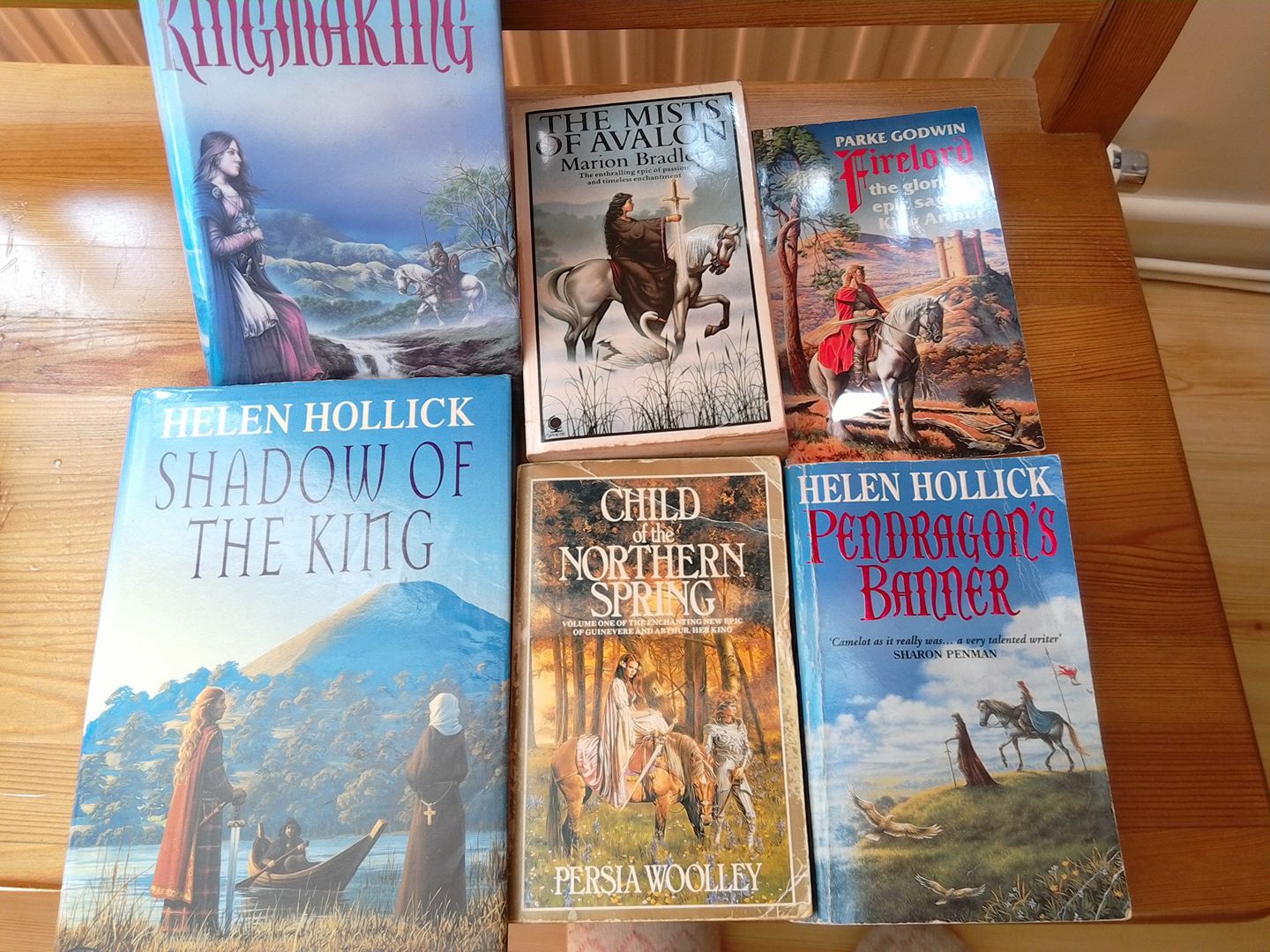
And yet, on one shelf alone, I have six novels, by four authors, and they are all stories of Arthur.

So, why? What is it about these books that caught - and held - my interest? I've tried to list these books in the order in which I first read them, but memory plays games, doesn't it? 

The only one I can pin down with any certainty is Parke Godwin's Firelord, because I remember my sister recommending it to me, along with Sharon Penman's The Sunne in Splendour, for something to read to fill the evenings when, having recently graduated and in my first job, I was living on my own for the first time.

I know I read Helen Hollick's books after I'd discovered Sharon Penman, and the date inside my copy of the first in her trilogy suggests that I came to them nearly a decade later. I would swear I read Persia Woolley while I was still a student, but I graduated in 1985, and my copy is dated 1988.


Thus, I think the first of these books to entertain me was The Mists of Avalon by Marion Bradley (my copy is dated 1983)

Now, despite what I've just said about not liking too much magic and mysticism, this novel is told from the point of view of Morgaine, who has the gift of 'sight'. In some respects this is a fairly faithful recreation of the Arthurian legend, but there are twists, most of which I can't reveal for fear of spoiling the plot. 

Morgaine is not an evil witch, and although she remains responsible for much of what happens, she is given a believable and poignant backstory. Some characters from the legend are fused, so that Galahad is also known as Lancelot, but others become three dimensional; in particular, Gwenhwyfar, who has a more powerful reason for her betrayal of Arthur than simply being smitten by a dashing knight. The clash between the old and new religions adds a powerful dimension to the story, too, and roots it more firmly in its historical context.

Bradley's story is told through the eyes of the women, but Parke Godwin went completely the other way and made Arthur the narrator. My copy of Firelord is dated 1980 but I must have read it around 1986-87.


Arthur lies dying, and looks back over his life, dictating to the young monk, Brother Coel. It's a surprising reworking of the story: 
"Damn it, I haven't time to lie here. Whatever comes, there's more for a king to do than squat like a mushroom and maunder on eternity."
Godwin gives Arthur a distinctive voice, and his tale is one based on such history as consensus suggests we have; that Arthur sprang from the dying embers of Roman Britain. Again, Morgana (as she is called in this version) is a sympathetic character. The love stories do not play out quite as expected, and while there are still certain elements of the legend, I recall that my sympathies ended up lying in unexpected places. The characterisation was sharp, different, and refreshing. 


Persia Woolley's Child of the Northern Spring shifts the focus back onto the female perspective. This is volume one of a trilogy, and for reasons long-forgotten now, I didn't ever read the other two volumes. Much of the first volume is taken up with Guinevere, daughter of the Cumbri, whose leader is the king of Rheged. She journeys from her homeland to marry Arthur, recounting tales from her past as she goes. Characters from the legend appear, such as King Mark and Tristan, along with Uther, King Lot and Igraine. I remember as I read this book that it didn't feel like I was reading the tale of Arthur necessarily, but a book set in similar times and with similar characters. Years later, watching the film First Knight, with its emphasis on Guinevere having come from a different country, I was reminded of Woolley's book.

Helen Hollick's Pendragon Trilogy dispenses with all the fantasy/magic elements of the tale. In this version, Gwenhwyfar is still the daughter of a foreign king, but in this instance she is the progeny of Cunedda, king of Gwynedd. To describe Hollick's Gwen as 'feisty' is to do her a disservice. She is courageous, and she is more than a match for Arthur.

The love story is far from simple and is satisfying, but what really struck me about this telling of the legend is that it simply didn't feel like I was reading about fictional characters at all. Removing the sorcery and leaving behind just the swords, the author paints a picture of a time in history, just as believable as anything from the pages of a Penman or a Chadwick historical novel. 

Unlike with Child of the Northern Spring, I never lost sight of the fact that this was the Arthurian tale, but I believed in these characters as real, historical figures. It was an indulgent delight, too, that just as with Penman's Welsh trilogy, I was able to settle down with not one, but three chunky volumes. I stayed with these people so long, that they occupied my thoughts for a long while afterwards.

So, no, I'm still not a huge fan of the non-fictional Arthur. I make a vague mental note when yet another theory emerges about him, that he was a Welshman, a Scot, a Yorkshireman, but where his appeal lies for me, is in his capacity to be so many things to so many different authors, and the proof that a tale can be retold in numerous ways, and always have something new to say.

Which Arthurian novels have you read, and loved, and why?

Wednesday, 7 June 2017

Regularis Concordia - the Rule Book for Anglo-Saxon Monks

In the tenth-century, three men worked hard to restore the monasteries to their former glory. All these men were subsequently venerated as saints: Dunstan, Oswald, and Æthelwold.

In particular, Æthelwold of Abingdon, later bishop of Winchester, was determined that the monks and nuns of England should follow the Rule of St Benedict.

Æthelwold was the author of the Monastic Agreement of the Monks and Nuns of the English Nation, or Regularis Concordia, a document with which I'm familiar because of the wording of its preface, and the fact that, in it, Æthelwold acknowledges the status of Queen Ælfthryth, wife of King Edgar, and a leading character in my book, Alvar the Kingmaker.


A page from Regularis Concordia

However, having finished my latest piece of research, for an upcoming publication for Pen & Sword Books, I thought I would study the content of this rule book in a little more detail, to find out what those tenth-century monks and nuns could expect of their daily routines.

Some of the rules are very specific: 

"[during Lent] Whenever the subdeacon wears a chasuble he shall take it off when reading the epistle, and put it on again as soon as he has finished. The deacon, too, before coming forward to read the gospel, shall take off his chasuble, fold it and then adjust it crosswise about his left shoulder, making the lower end thereof fast to the girdle of his alb."

"On those same days of Lent when the Mass is ended, the bell shall be rung for Vespers and there shall be a space for prayer. Then, in the interval while the bells are ringing, those ministers who wish to shall partake of the mixtum; those who do not wish to shall have permission to forego it."

Such detail is the stuff one imagines being drawn up by committee, and there are sections of the Rule where one can hear the provisos echoing down the centuries:

"The brethren, vested in albs, if this can be done and the weather permits, shall go to the church."
If wet, in the village hall?

Much of the Rule is taken up with such ritual - the order of service for every part of the day, and the canonical year, is laid out. "None shall be recited when the second bell has rung. After None, they shall say for the King, Queen and benefactors the psalms Qui regis Israel and De profundis...rising up from the meal, they shall give themselves to reading or to the psalms...Vespers shall be celebrated punctually..."

However, there are also rules which cater for the basic human needs: "Thus in winter, when storms are harsh and bitter, a suitable room shall be set aside for the brethren wherein, by the fireside, they may take refuge from the cold and bad weather."


St Benedict by Fra Angelico

There is a chapter dedicated to the care of the sick within the monastic community: "Let there be therefore in that house brethren...who shall furnish the sick brother with everything he wants; if indeed it is necessary, let the help of servants be employed under a careful brother." Later, it states that "If the sickness improves, the visiting shall be discontinued, but if not, it shall be kept up until the death of that brother." There are further instructions for the washing and laying out of the deceased's body. 

This rule book is so much more than a prescription for the litany. Every aspect of daily conduct is considered. Were they a silent order? It seems not:

"The auditorium is excepted from the rule of silence; indeed, it is called by that name chiefly because it is there that whatever is commanded by the master be heard; neither is it right that tales of gossip should go on there or anywhere else." 


Now, as a teacher and a parent, I know that rules aren't laid down for no good reason. It makes me smile to think that these monks must occasionally have been prone to tittle-tattle.

Safe-guarding is also evidently nothing new: "Not even on the excuse of some spiritual matter shall any monk presume to take with him a young boy alone for any private purpose but, as the Rule commands, let the children always remain under the care of their master. Nor shall the master himself be allowed to be in company with a boy without a third person as witness."


Much is said about confession, and those who are "conscious of the guilt of sin or of weakness of the flesh shall not hesitate, in their fervent practice of the exercises of the monastic state, to receive the Eucharist daily...let those who are invited to the Lord's Supper beware lest, stained with the filth of sin, they dare to draw nigh to it unconfessed  and unrepentant."

But it was not all prayer, confession and hard work:
"On Saturdays, the brethren shall wash their feet, for which purpose each shall have a suitable basin. Having washed their feet, those who need to shall wash their shoes also."

Then "the prior shall strike the little bell and all shall assemble with thanksgiving to draw their measure of drink."

Alas, this was only a precursor to more prayer and only then could they file into the refectory.


Reading this document, one gets a sense not only of the seriousness with which the Rule was supposed to be observed, but of the daily rituals and concerns of those who led the cloistered life. Hitherto, I had only known of the historic and political importance of this document, its place in the timeline of the great monastic reform of the tenth-century, its bold statement affirming the status of the King's wife, and its enjoining of her to become the "fearless guardian of the communities of nuns" and its role in placing Æthelwold of Abingdon in the history books as one of the leading lights of the reform movement.


Now I feel I know a little of those anonymous black-robed monks, who lived behind the monastery walls, who were free to "give themselves voluntarily to private prayer" but who must not "dare to enter and frequent the places set apart for nuns." 

When they were on a journey, they were not to "waste time in idle talk," but when receiving visitors they had to be "most zealous in providing every kind service in the guesthouse." Indeed, it was laid down that "wayfarers, shall on their departure be provided with a supply of victuals according to the means of the house."


I can see them now, bustling about their daily business. This little rule book meant much to the reformers, and to the monks. It's also been invaluable to me.

Older Anglo-Saxon blog posts:
Anglo-Saxon Names
Wulfric Spott: A Mercian Man of Means

Wednesday, 10 May 2017

On Anglo-Saxon Marriage

Tradition has it that it wasn't much fun being a married woman in medieval times. Novels and films often lead us to believe that men were entitled to beat their wives, that women had no say in whom they married, that all their property belonged to their husbands etc etc... Was this true, and more pertinently, was it true for the Anglo-Saxon period?


A document, Concerning the betrothal of  a woman, suggests that it was not.
"If a man wishes to betroth a maiden or a widow, and it so pleases her and her kinsmen..."
It seems that the woman herself had to accept the suitor before the betrothal can proceed. Furthermore:
"The bridegroom is to announce what he grants her in return for her acceptance of his suit, and what he grants her if she should live longer than he... then it is right that she should be entitled to half the goods - and to all, if they have a child together - unless she marries again... he is to strengthen what he promises with a pledge, and his friends are to stand surety for it."
Clearly, whatever she is granted is guaranteed, and is hers to keep if they have a child together. It seems like quite a civilised arrangement, affording her a little bit of financial security.

The document bears no date, but it has been suggested that it probably dates from somewhere between 975 and 1030.


What other sources can shed light on the property rights of married women?

A marriage agreement between Wulfric and Archbishop Wulfstan's sister, dated somewhere between 1014-16, seems to confirm the guaranteed grants.
"He gave her the land at Alton to give and to grant to whomsoever she pleased during her lifetime or after her death."

An Old English agreement from Kent, dated between 1016-20, explains that, when Godwine wooed Brihtic's daughter,
"He gave her a pound's weight of gold in return for her acceptance of his suit, and he granted her the land at Street with everything that belongs to it, and 150 acres at Burmarsh and in addition 30 oxen,  and 20 cows, and 10 horses and 10 slaves."
and makes clear that: 
"Every trustworthy man in Kent and Sussex, thegn or ceorl, is aware of these terms."
These are agreements between families. What can the lawcodes tell us?

The laws of Ethelbert of Kent 602-603 decree that: 
"If anyone lies with a maiden belonging to the king, he is to pay 50 shillings compensation. If it is a grinding slave, he is to pay 25 shillings; if a slave of the third class, 12 shillings."
So, not too helpful, except to tell us that slaves had varying value. Although later in the same code we learn that:
"If a freeman lies with the wife of another freeman, he is to atone with his wergild*, and to obtain another wife with his own money, and bring her to the other's home." 
Oh dear; definitely a case of 'spoil my property, bring me a new one.'

And yet, we read that,  
"If anyone buys a maiden, she is to be bought with a bride payment." 
And that, 
"If she bears a living child, she is to have half the goods, if the husband dies first. If she wishes to go away with the children, she is to have half the goods." 
But, if anyone,
"carries off a maiden by force, he is to pay to the owner 50 shillings."

The later laws of Kent (673-685) dictate that:
"If a husband dies leaving wife and child, it is right that the child should accompany the mother, and he is to be given one of his paternal kinsman as a willing protector."

Wihtred of Kent's laws (695) declare that: 
"foreigners, if they will not regularise their marriages, are to depart from the land with their good and their sins."
No doubt this is a reference to religion and law, rather than any protective prescription for women.


Alfred's laws in the ninth-century seem to suggest that any affront to women is actually an insult to the men who 'own' them: 
"And a man may fight without incurring a vendetta if he finds another man with his wedded wife, within closed doors or under the same blanket, or with his legitimate daughter or his legitimate sister, or with his mother who was given as a lawful wife to his father."
But his laws also place special emphasis on the pregnant woman: 
"If a woman with child is slain when she is bearing the child, the woman is to be paid for with full payment  and the child at half payment  according to the wergild of the father's kin."
and, 
"If anyone rapes a girl not of age, that is to be the same compensation as for an adult."

King Æthelred the Unready's code of 1008 mentions that:
"Each widow is to remain unmarried for twelve months; she is then to choose what she herself will."
This suggests that a woman had a fair amount of choice, dispelling the notion that women were married off for monetary or political gain.


It's fair to say that the codes are mainly concerned with law, property, punishment, thievery, murder and rules of trade, as well as observance of holy law. But these women do get a mention. They are at least considered, and they do have rights.

Although, in the laws of Cnut, a man committing adultery is to pay compensation for it, according to the deed,  but if a woman commits adultery during her husband's lifetime  she becomes a public disgrace, forfeits her goods, and loses her nose and ears. So there's a little disparity there...

But if any man dies intestate, the property  is to be: 
"Very justly divided among the wife, the children and the close kinsmen, each in the proportion that belongs to them."
Cnut's laws also expand on Æthelred's, concerning the widow who remains unmarried for twelve months, decreeing that if she remarries, she forfeits the morning-gift and other possessions obtained through her first marriage. But,
"A widow is never to be consecrated as a nun too hastily" 
and, 
"neither a widow nor a maiden is ever to be forced to marry a man whom she herself dislikes, nor to be given for money, unless he chooses to give anything of his own freewill."
So, by the 1020s at least, women could be safe in the knowledge that they could not be forced into marriage, or into a convent.


But I'll close with this last little nugget. If a man brings stolen property into the house, unless it is under the wife's lock and key, she is not deemed guilty. But, 
"she must look after the keys of the following: namely  her store-room, her chest  and her coffer." 
If the stolen property is found in any of these, she's guilty.

Imagine the eleventh-century housewife's frustration, though, that: 
"No wife can forbid  her husband to place inside his cottage  what he pleases."
After the equivalent of a late-night drunken internet shopping spree:-

"Wulfgar, tidy up that 'bargain second-hand shield, one careless owner, slight spear damage'. And no, you can't put it in my coffer."

"Well, it'll just have to stay on the table, right next to the relic of St John the Baptist's foot, 'only three left in stock'. And there's nothing you can do about it." 

*Wergild - essentially a 'man-price': the value of a life, depending on rank

Other related posts:
Anglo-Saxon Names
Wulfric Spott: A Mercian Man of Means
A Brother Receives a Letter - and a Telling-Off

Wednesday, 19 April 2017

A Brother Receives a Letter - and a Telling Off

I do a lot of research, often revisiting a particular few years of the tenth century which are perhaps less well-known but are of great interest to me. From 955AD to around 980 there was little in the way of Viking activity in England but there was plenty of political manoeuvring, quite a few convenient royal deaths, and oh, a couple of civil wars... 

Most of the documents I study were written by clerics, and usually about 'important' people - kings, heirs to the throne, wives and women of kings. Almost all of these are mentioned as part of the stories of clergymen, those venerated as saints.


But tucked away at the end of a huge book*, my go-to source book, in fact, I rediscovered this gem, a letter written to a 'brother Edward'. It's written in the vernacular, a rarity for this period, and if one reads it as if it's addressed to a family member, it takes on a surprisingly contemporary tone, even though it addresses concerns very specific to the time of the Danish invasions:

"I tell thee also, brother Edward, now that thou hast asked me, that you do wrong in abandoning the English practices which your fathers followed, and in loving the practices of heathen men who begrudge you life, and in so doing show by such evil habits that you despise your race and your ancestors, since in insult to them you dress in Danish fashion with bared necks and blinded eyes. I will say no more about that shameful mode of dress except what books tell us, that he will be accursed who follows heathen practices in his life and in so doing dishonour his own race."
Elsewhere in the letter, the author asks Edward to try to stop 'a disgusting habit among women in rural districts, since he more often goes among these than does the writer'.

This made me smile. In fact there is so much that is wonderful about this missive, not least the opening line, "Now that thou has asked me..." 

Is there a little bit of smugness, too, that it is only Edward who goes more often among women in rural districts? I note that the writer implies that he does occasionally venture there himself, but never so frequently as the wayward brother. And what is the 'disgusting habit'? We are not told. Is this because this letter was not written for posterity, but simply to a brother gone off the rails? One can almost hear the drawing of breath, the whisper, "You know exactly what I'm talking about."


Obviously written at the time of Danish invasion, this letter is a delight, not only for its rarity but because of the wonderful image it conjures up. One can imagine that Edward is mixing with the wrong crowd, has quite had his head turned by the fancy and trendy invaders and has taken, much to the author's, maybe his family's, consternation, to following this new fashion. The 'blinded eyes' does not refer to 'cool shades', but one feels it is the middle-ages equivalent. 


Plus ca change...

*English Historical Documents Ed Dorothy Whitelock

Other related blog posts:
Anglo-Saxon Names
Wulfric Spott: A Mercian Man of Means

Tuesday, 4 April 2017

No Alums, Veri Pore: The Norwich Census of 1570

Going through some old history notes recently, I came across this little gem of a document. I've no idea how I came by it, (I have a facsimile; I don't think I'm on any museum or library 'wanted' list!) but as an historian who has close ties with Norfolk, I found it of great interest. I know Norwich very well, and I also love to pick at primary source documents to see what they can tell us of the people who lived in centuries past.

It contains details of the Parishe of St. Stevenes. The chancel of St Stephen's Church dates from 1522, and the church is one of three in the 'New French Borough', an area near the castle where 98 Saxon homes were demolished to build the stone edifice which signalled that the Normans were here to stay.


St Stephen's Church, by Ian Capper via CC Licence

In the later medieval period, around a third of the population of Norwich was made up of 'Strangers', Flemish Protestant Refugees. The famous Strangers' Hall in Norwich is only a five minute walk from St Stephen, but the first census entry I looked at was of the Rowe family, who have dwelt here ever, in other words, they were 'natives'. The head of the family, Robert Rowe, was 46, a glasier, and in no worke. His wife Elisabeth that spinne white warpe had five children. They lived in Thomas Mason's house and received no alms.


Strangers' Hall  - Public Domain Image

John Hubbard, 38, was a butcher and he and his wife had also dwelt here ever, but unusually for a butcher, his status was registered as no alums but verie poore.

Thomas Pele, 50, was a cobler in worke and Margarit his wyfe of the same age that spinne white warpe had three children. The elldist of the age of 16 yeres that spinne, and the other of the age of 12 and of 6 yeres that go to scoole, and have dwelt here 9 yeres and came from Yorkshere. Thomas and Margarit both had work, and the youngest children went to school, and yet they lived in the parish house, with no allums but verie pore.

John Tastes, a cordiner (cordwainer), and his wife who sewed, had two children at school, and lived in Mrs Broune's house with no alums, indifferent.


Mousehold Heath, Norwich - John Crome, Public Domain

John Burr was a 54 year old glasier, but verie sicke and worke not and his wife Alice that spinne had 7 children. The youngest was 2 yeres that can spinne woole. They lived in John's own house and had dwelt here ever.

The eldest on this document is John Findley, who at 82 years was not registered as 'past work' as some other elderly residents of Norwich were, but simply listed as a cowper not in worke along with his wife, Jone, who was siklie and yet spinne and knitt. They also had dwelt here ever, but in the church house, with a payment of 4d, and they were verie pore.

A quick scan of the whole Norwich census reveals that very few people, if in receipt of any payment at all, had any more than 4d.

To give an idea of the amount 4d would buy,

In another part of Norwich, in the Parish of St Gregory's, a poor man died, and his property was valued in an inventory taken by William Rogers and Gregorye Wesbye on 15th October, 1599.


St Gregory's by Adrian S Pye, via CC Licence

One borded bedsted 3s. 4d
One mattress and one under cloathe 1s. 6d
One flocke bed 2s. 6d
One bolster 2s. 0d
One downe pillowe and an old cushaigne 1s. 6d
Two leather pillowes filled with feathers 3s. 4d
One payer of shetes 2s. 0d
One bed blanket 1s. 8d
One old cofer 2s. 0d
One drye barrell 3d
2 salt boxes 1s. 0d
One hake, a fyer pann, a payer of tonges and a rosting yron 1s. 6d
One litle ketle, a sawer and 3 pewter spoones 2s. 6d
3 little boles 1s. 0d
One ketle, one potspone, 28 trenyens 1s. 0d
2 woodinge platters and 5 dishes and twoo erthen potts 8d
a stone pott and 5 galley pottes 4d
a hamper and certen old washe 6d
4 frayles and 2 stooles 3s. 0d
3 chiselles, 2 hamers and a perser 3s. 0d
(suggesting he was a carpenter by trade)
3 old cushings 6d
2 payers of hand cuffes and one dozen of hand kerchers and an old pillowbere 2s. 6d
2 old shirtes 1s. 8d
One old forme and 2 old cappes 1s. 0d
Total: £1 18s. 5d


Strangers' Hall Museum - a richer setting than our census houses

Ever wished to go back in time? Much as I love Norwich, I think I'd go back as a wealthy merchant. At the very least.